Showing posts with label "ICT enhanced learning and teaching". Show all posts

Tuesday, August 2, 2011

The conversation prism: Visual way of representing the networking realm

Sometimes, once you have worked through your design stages (and this could be for a whole programme or for an activity), you may then be left wondering what tool would be suit your needs, given the approaches and interactions you have planned for. You might, for example, have decided that you are going to use a problem-based focus and one of the things you would like your learners to do is access experts from all around the world. To do this you might encourage your students to access niche networks.


However - how do you work out the connections, and find out what is available? Bring on the following two diagrams: Pedagogical underpinnings to ICTELT design and The Conversation Prism. The first looks at some possible pedagogical approaches, and ties them with activities. The second outlines broad communications and interactions, and then suggests a few of the tools that could be accessed and used by your students. I've found it really useful...and it would be good to know if you have any examples or suggestions how you have used these tools :-)
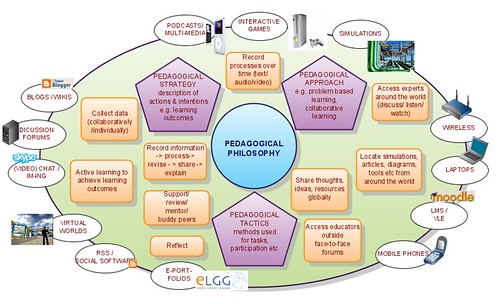


To access this image full size please click HERE (by hazelowendmc)
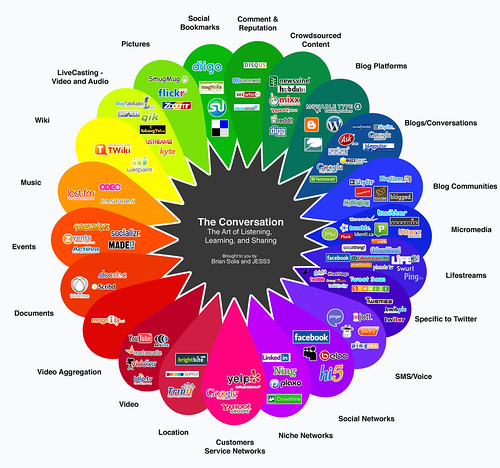
To access this image full size please click HERE (by b_d_solis)
Enhanced by Zemanta

Thursday, June 24, 2010

Personalised learning for English language learners at school in New Zealand

ICT Enhanced Learning and Teaching Process ModelImage by hazelowendmc via Flickr
This is a quick overview to one of the projects that Ethos is involved in - the English Language Learning in New Zealand (ELLINZ) blended learning programme. The ELLINZ design and development team is working with the Ministry of Education in NZ to find a blended learning solution that will assist students learning English as another language before they move into mainstream classes, especially in schools where there is little or no specialist ESOL support. The staff on the design team work collaboratively, enabling a cross functional, multi-skilled team environment, sharing an online project team working space and collaborative documents. An ICTELT blended design has been developed for this pilot intervention, initially through the use of the ICTELT model and suite of tools (e.g. process model, framework, and mindmap).

The main focus is to offer personalised learning in an environment with students engaged in activities where they are able to generate and co-construct knowledge through their interactions with other learners and teachers and with the activities and opportunities provided. The underpinning design places great importance on the students' background, culture and learning preferences. Learners will be supported by an eTutor in face-to-face and/or asynchronous mode, as well as with a designated off-site eTeacher who acts as a learning coach who guides and collaborates with students, partly through facilitating weekly webinar sessions with geographically diverse students. The programme of learning is to be mainly hosted in a Learning Management System (Moodle) site that functions as the formal hub for learning activities and resources. Asynchronous communication with peers, reflective activities, social interaction and learning, and communication with the eTeacher is hosted in a social networking space (Ning). Assessment (both formative and summative) is embedded within the programme, and includes peer-feedback and self-assessment. The project is just completed the trial phase, and evaluation will be collected from the students, eTutors, eTeachers, and support staff who have been involved. This feedback will be fed into the build of the pilot programme, and a formal research study will be carried out to measure whether the ICTELT blended design approach assists second language acquisition, as well as its effects on affective factors such as motivation.

To see this video full size go to: http://blip.tv/file/3791723


Enhanced by Zemanta

Tuesday, April 27, 2010

Three generations of distance education pedagogy: Challenges & opportunites (Terry Anderson)

A tag cloud with terms related to Web 2.Image via Wikipedia
This was the first keynote of the second day of the DEANZ 2010 conference, and was given by Terry Anderson around distance education pedagogy and the changes and growth that have been observable over the last three generations. He starts by indicating that the first generation of distance education was based on behaviourism and cognitivism, which looked particularly at independent learning. The second generation was based on constructivism and groups, and, finally, the third generation is linked to notions of connectivism (which built on theories of participatory pedagogy, complexity, and trandparency).

The newer generations of distance education are still working concurrently with the earlier generations, Anderson suggests. As such, designers, developers and educators are challenged to enhance learning and teaching opportunities by increasing access to quality learning contexts and opportunities.

Motivation, structural support and cognitive skills are key in distance education where the group, network and collective aspects (the unconscious aggregation of activities of all of us) of learning can be foregrounded. The connectivist tools (over 3,000 of them) are wide-ranging and are based on Web 2.0 (check some of them out on the Go Web 2.0 site). The sheer range may offer an insight into why some education practitioners choose to use an LMS - the choice is just overwhelming.

Terry Anderson gave a range of examples from Athabasca, including using ELGG to build a social networking community, as well as using podcasts, vodcasts, and screen casts. Some of the most concerning issues raised were around using the connectivism model were privacy, control, dealing with disruptive change, institutional support, and sustaining motivation and commitment to avoid running after fads all the time.

The thing I found most interesting about this presentation was the recognition that there is still a combination of all generations of distance education, with the inference that many educators and institutions are still working with earlier models. Also, Anderson closed by posing the question: "which type of student is most engaged by each generation?".
Reblog this post [with Zemanta]

Tuesday, November 10, 2009

Where do I Start? Integration of ICTELT into blended curricula

Abstract:"The potential of information communication technology (ICT) to enhance learning is under-utilised even though there are numerous process models and frameworks have been developed to assist in the design and / or adaptation of curricula. Issues with many existing design models are complex and range from the pragmatic, such as resource requirements, skills and ownership of a project, to models being mechanical, inflexible, hierarchical and / or impenetrable.

This session starts by exploring the learning and teaching value ICT can add to curricula, and then describes a process model and framework that I have adapted from existing examples. The accessible, scaffolded approach described is appropriate for very small teams or individuals working with few resources to develop resources ideal for instructors interested in blended learning and/or distance approaches.

The pedagogical underpinnings of a design process are outlined, in which practitioners identify a teaching and learning problem and assess whether ICT could enhance learners experience of new or existing programmes, modules, units, sessions, or learning objects. Guiding questions are posed to help support the process, and an iterative practice is encouraged whereby a design is developed, piloted, evaluated, revisited, modified and re-evaluated over time, with recognition that the practitioners experience, skills and attitudes are likely to shift.

The practical application of the model and framework is illustrated through an example developed for use in Moodle at UnitecNZ.

The model and framework have yet to be piloted and MoodleMoot will offer a hands-on opportunity for participants to experiment and evaluate the tools in this session by identifying a resource or session that they would like to adapt. Then, working collaboratively, in Moodle they will work through the first part of the process model by completing the framework. Feedback and comments will be gladly accepted."

Associated sites: Slideshare: http://www.slideshare.net/hazelowendmc/where-do-i-start-integration-of-ictelt-into-blended-curricula-presentation

Wiki: http://efest2008collaboratingbydesign.pbwiki.com/

Please cite as: Owen, H. (2008, October 8-10). Where do I Start? Integration of ICTELT into blended curricula. Paper presented at the MoodleMoot NZ 08, Eastern Institute of Technology, Hawkes Bay, New Zealand.

Information literacy skills - disipline-specific, online tutorials


You might like to check out these online, discipline-specific tutorials from the 'Virtual Training Suite'. The blurb on the site describes them as "a set of free Internet tutorials to help you develop Internet research skills for your university course", and goes on to say that "All our tutorials written and reviewed by a national team of lecturers and librarians from universities across the UK". The estimated time for each tutorial is one hour of self-directed study.

Tuesday, September 1, 2009

Design and scenario: Web 2.0 ePortfolios for students

Image source: http://www.flickr.com/photos/waltstoneburner/3375027629/

I have been working on developing a scenario and design mindmap that explored some of the potential of Web 2,0 ePortfolios for learners. Given that I am currently working with Unitec NZ I decided to base my fictional learner, Chan Sook, at this institution studying The Bachelor of Business (Accountancy).

You can access the mindmap at http://www.mindmeister.com/25663129/chan-sook-learner-eportfolio and the accompanying scenario (which includes a list of Web 2.0 tools she uses, and how she uses them) at http://docs.google.com/View?id=dcqj5jv4_50cfd7tbfw.

Any comments, feedback or ideas that you may have would be gratefully received :-)


Monday, August 3, 2009

Podcasting for LLN - a taster session

Vickel Narayan and I ran a 1 hour workshop (with Yong Liu as invaluable support) at the LLN symposium at Unitec NZ on 15th July 2009. The abstract for the session was: "Ongoing results from the field indicate that using multimedia with learners can be highly effective, especially where LLN challenges are being faced. Have you considered using audio tools? Would you like to try podcasting? In this 1 hour session you will find out how to adapt existing resources to audio, record in a digital format, and make the resulting files easily available to students as podcasts. You will need to bring print material (about 1-2 pages of text) which you have found students have found challenging in the past."

It was a little frantic during the setting up as we arrived 1/2 an hour early to get all of the laptops set up (with headphones that we'd begged, stolen and borrowed - mainly Vickel). A compromise was reached and the 26 participants rolled up. We had set up a Ning (http://podcastunitec.ning.com/) for the session with resources participants could access after the 'taster' workshop. We had also set up a Podomatic site so that podcasts could easily be uploaded (http://unitecnzpodcasts.podOmatic.com). After introducing the session and showing a great short video that explained what podcasts are (http://podcastunitec.ning.com/video/whats-a-podcast), we asked everyone to work in pairs at a computer. We used a 'how to...' video that went over the basics of recording an audio file in Audacity, exporting it, and then uploading it to Podomatic.

There were some glitches, but on the whole everything went smoothly and everyone enthusiastically figured out what to do. Toward the end of the session we played a successful podcast that had been made and uploaded during the session. It seemed to go really well and people seemed to be pretty inspired.

The feedback for the session was mainly positive. People were excited by the possibilities and potential for LLN, and others had a real sense of achievement, mastering skills that they did not previously have. The hands on nature of the session was appreciated, although the very large number of participants who had been signed up meant that even with Vickel, Yong and myself, it was tricky to keep up with requests for assistance. The ideal size of sessions like this is around 10 participants maximum. Some people were frustrated by technical glitches (for instance the Podomatic site ground almost to a halt once 15 sets of people started to upload podcasts...to the same account. This meant that some people were not able to listen to their podcast during the session, but had a link and login details in the Ning so that they could have a listen later - not quite the same though). All in all, though, an invigorating and exhausting session! :-)