Showing posts with label creative commons. Show all posts

Tuesday, August 28, 2012

Making connections: 10 TED Talks That Could Be Used As Course Titles

Literacy...
Literacy... (Photo credit: hazelowendmc)
Why do. people give so much time, thought, and often, effort to sharing, commenting, and participating in online environments - for free? An inherent desire to share and receive feedback? The great moment when you make connections across topics, or someone Tweets back a link to the answer you have been searching for? To be extended and challenged in your thought? For me, it's all these and much, much more.

A concrete example from today's work for me was the 10 TED Talks that could be used as course titles...the Committed Sardines 21st Century Literacy Project was shared by Vicki Hagenaar (here), a quick perusal led me to Ross Crockett's post referring to 10 TED Talks, and finally to the Edudemic ezine where Katie Lepi had written and posted the original article. She had been inspired by a Twitter conversation to write a post that combined the thought-provoking TED Talks with course design. Wheels within wheels! And all freely available as inspiration.


An extract from Katie's post reads:

Long story short, most [course titles] are still stuck in the dark ages. Biology 101? World History 1812-Present? These titles may seem like they’re accurate and fit but… they’re boring.
In an effort to give school administrators and teachers a guidepost with which they can rethink current course titles (what better time than in July, right?), I offer up the idea being shared on Twitter this morning: that we take a page from TED and offer courses using their naming schema. In other words, make the course titles sexier, the descriptions more attractive, and get students excited to attend a class before they even step foot in the classroom for the first time.
So, without further ado, here are potential course titles that are actual TED talks / TED categories. I’ve put the actual name followed by what course it could actually be below it. Click the big title to learn more about each topic.
Read more here>>>
Enhanced by Zemanta

Friday, June 15, 2012

OER: The quality vs credibility vs access vs pedagogy vs legitimacy vs money debate (Dave White)

The conversation around Open Educational Resources (OERs) , Copyright, Intellectual Property, fair use, and Creative Commons licensing is rumbling along. The outcomes seems to be reasonably inevitable to me, with those organisations that distribute, for example music, using a system that is rooted in an now outmoded business model are looking at rather a sticky end - evolve or die as the saying goes.

Vasi Doncheva shared via Twitter (@playnice_nz) "a thought provoking post with useful links and discussion about how OERs affect pedagogy". The post, entitled Open Educational Resources and Pedagogy (by Jenny Mackness) features a summary of Dave White’s presentation, as well as a link to the audio from his session.

(Slide 6 from Dave White’s presentation, sourced from here)

Jenny highlights the fact that:
when thinking about OERs we cannot neglect ‘contact’. It is not all about ‘content’. So how do OERs ‘drive pedagogy back into what it’s meant to be’? (quoting Dave from the presentation). For me they do this in a number of ways:
  • Now that we have more clarity around what we are allowed to do with OERs (through Creative Commons Licences), we can remix, repurpose and feed-forward OERs (to quote Stephen Downes). We can be more creative.
  • Perhaps OERs also enable us to challenge the ‘status quo’ – in the sense that ‘credible, quality’ content might no longer always be in peer reviewed journals, articles and academic sites, but might instead be on ‘John or Jane Doe’s blog’ or deep below the water line (iceberg metaphor).
  • They do tend to force more critical thinking and the framing of critically relevant questions, e.g. what is a credible, quality resource? How do we recognize it?  And this in turn raises the whole question of whether learners have the skills to navigate the web to find the quality resources.
  • And from the teacher’s perspective, as Dave pointed out, we will have to come up with assessment tasks that don’t allow the student to simply find the answer through an easy access easy to find OER. This has always been a challenge for teachers, but even more so now."
 Would be good to hear your thoughts on the points that Dave and Jenny make.
Enhanced by Zemanta

Saturday, June 2, 2012

Opening up the world with open reading

Richard Elliott has some peaches in his eLearning Watchfor May. A couple that I was particulary taken with are The Open Library and The Open Academic Textbook Catalogue.
The Open Library
This amazing resource offers a searchable (editable) database, with, once you find a book you want oppoprtunties to read, borrow, and/or buy. Some books only have the buy option, but many have a download option in a wide range of file types (or you send to your Kindle - which I didn't try as I don't have a Kindle :-)).
Richard described the library as follows: "The Open Library. Is an ever-growing repository of books of all types and subject. It is an open project: the software is open, the data are open, the documentation is open, and contributions are welcome. Already the site claims to have over 1,000,000 free e-book titles. Plenty you will recognize and maybe read or direct your students to."


If you are studying, or just interested in learning this is the place to go. The easily searchable site offers textbooks to print (at a cost, but way less than it would cost to buy from a shop), as well as in the following formats .PDF, audiobook, EPUB, mobi, and 'read online' (usually free). As Richard says, "Always good to see efforts being made to ensure educational resources can be obtained freely and with minimum cost or no cost at all. This initiative is great and is open to any faculty world wide".


Enhanced by Zemanta

Thursday, January 19, 2012

Wikipedia blacked out to protest

Michael Winter shared the announcement that Wikipedia has been "blacked out for 24 hours to protest against proposed legislation that threatens freedom of expression on the Internet.To find out more try accessing Wikipedia as normal or go to: http://en.wikipedia.org/wiki/Wikipedia:SOPA_initiative/Learn_more". Michael also indicated that he thinks it "seems like a good way to get support for a worthwhile protest".


Nick Ford added the comment "For me a locked down/user pays manifestation of the Internet rather than the Internet the world is currently blessed with is something to be vigilant against. For more information visit Stanford Centre for Internet and Society (CiS) and read 'STOP SOPA'. Lawrence Lessig is the founder of CiS and Creative Commons".
Image representing Creative Commons as depicte...Image via CrunchBase

I wholeheartedly agree that the Internet needs to remain as open and accessible, and that the whole notion of copyright is an outmoded, artificial construct that has been placed on creativity and innovation by folk who see a direct cause and effect between the creation of something, and making a buck. The reason I feel it's artificial is that invention and art (to name but two) have always been a constant collaborative effort, where one thing builds on another - often extending it. The lightbulb could not, for example, have been invented if a whole heap of work had not been done around electricity, resistance, and the materials required to make the physical object. How can you copyright / patent that?

WikipediaImage by Octavio Rojas via Flickr

The whole notion also raises interesting wider questions around what we believe to be freedom of expression, and where, if anywhere, the line has to be drawn. There is some content that pretty much unanimously human being are likely to agree has no place in society in general, and on the Internet in particular, and some forms of predatory behaviour that are also not acceptable. However, where subjects of morality, bias, and belief are 
expressed, what do we feel is 'acceptable' and why? When I find something objectionable should that mean it is removed? If the Internet is there for anyone to share their own world view, what if it seen as inciting violence by some, but as a way of promoting peace by another? And who makes the final decision? Would be great to hear what you think

Enhanced by Zemanta

Tuesday, March 8, 2011

Are you a teacher and / or Moodle aficionado? Can you help Christchurch students and schools?

CHRISTCHURCH, NEW ZEALAND - MARCH 01:  Student...Image by Getty Images via @daylifeAs you will be aware the earthquake in Christchurch, NZ has disrupted a huge amount of schools and students. Jacqui Land of Papanui High School is working with Moodle in Schools to find ways of reducing the long-term impact on students' learning, and has put out the call for help below. If you are able to help, please contact Jacqui Land or Margot McKeegan, or you can drop me a line and I will pass on your message.

The following was originally posted at Moodle in Schools- By Jacqui Land of Papanui High School on Mon, 07/03/2011 - 18:33

The GCSN (Greater Christchurch Schools Network) are trying to get some material up onto a Moodle 2 site asap to help schools and students who have been affected by the recent Earthquake. The idea is to upload material and courses onto this site and then share them with other schools via the Moodle in Schools HUB.

We are urgently looking for either people to upload the material onto courses on the GCSN Moodle site OR people who have lots of resources and / or good ideas. (The material needs to carry a Creative Commons license and be freely available to distribute to other schools).

If you are able to help we will be writing / producing courses from 9.30 am on Tuesday 8th March until Friday 11th March at South Learning Centre, 66 Colombo Street (cnr Hunter Tce and Colombo St), Christchurch. You do not need to commit to the whole time, but if you can spare an hour or so sometime during this period please feel free to pop in. You do not need to be a Moodle expert, we can provide training / help. Alternatively, we can provide you with access to a course and you can add content from your school or home.

Moodle-logoImage via Wikipedia
Enhanced by Zemanta

Wednesday, January 26, 2011

On the shoulders of giants: Creative Commons and commercial use (invited blogger of the month - January 2011)


A post by John Owen

Creative Commons (CC) provides the legal framework for creators to offer some rights to others under certain conditions, replacing ‘all rights reserved’ with ‘some rights reserved’. These conditions cover attribution to the creator, whether or not the work can be changed in any way, whether it can be used for commercial gain, and what form of licence must apply to any future use of the work. The NZ CC website has a good description of the licence combinations.

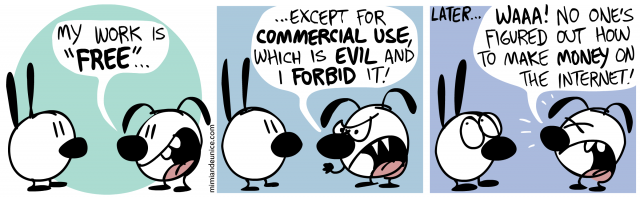
Of all these options, the most controversial and misunderstood is the right to (or restriction of) commercial gain. That is to say, if you issue a creative work under the CC licence, should you let others use it to make money?

I
mage source - by Mimi and Eunice

Search Flickr for CC images of your favourite subject and you will have a small subset of the overall content available under standard copyright protection. Restrict your search to a CC licence that allows for commercial use and you will have a fraction of the original content (if any, depending on your chosen subject).
Why is this the case? My suspicion is that the public understanding of CC licensing is misguided by the traditional copyright environment we are familiar with; that is to say, an environment that rewards ownership and stifles creativity. Put another way, we think that ownership rather than creative use endows us with the right to claim reward.

 
Image source - by lumaxart

The intention of CC is to create public goods (resources) for creative use by all, whilst at the same time allowing the creator to reserve certain rights. However, to be of future creative use to others it is essential not to apply too many restrictions. I would argue that, most importantly, we should not restrict the right for others to make money with these public goods. If someone can earn a living using my Pacific Island holiday sunset picture when I could not (or cared not to), should I expect much more than accreditation for a lucky snap?
To give a less trivial example, there are kiosks called Freedom Toasters that burn free and open source software (such as Firefox, Open Office, Ubuntu etc) as well as other social content onto disks for those who cannot download it from the Internet. The licences that these applications and content are distributed with do not prevent the kiosk maker or owner from charging for this service should they wish (the service is actually free). However, it would not be possible to distribute CC non-commercial content this way without agreement - in practice, it would be impossible. Licensing a relatively valueless creative work this way restricts the way it can be used to directly or indirectly benefit others.

The Freedom Toaster (Image source - by Breadbin Interactive)

I chose this (slightly convoluted) example because it touches on another important right, which is the human right to earn a living. Free and open source software supports this right, allowing others to earn a living from products licensed this way. And developers of free software feed themselves by offering support and customisation of free software. Free in this context is derived from libre rather than gratis; i.e. free speech as opposed to free beer, as Richard Stalmann (founder of the Free Software Foundation and author of many copyleft licences such as the GNU GPL) is often credited with saying. This is an organic and self sustaining model that not only works, but works very well. Overzealous protection of rights and ownership not only stifles creativity, but also denies many the right to earn a living; and instead allowing a small few to earn a fortune.

If you wish to support a truly creative environment from which we can all benefit then you should always consider allowing for commercial use. If you have no idea how to make money from your works, don’t stop someone else from doing so. The only restriction you should consider applying is one that ensures your licence cannot be changed in any future use.

What does this have to do with education? In New Zealand we are lucky enough to have the right to participate in primary and secondary education. If we were to make the course content free and open, then maybe some of the barriers to education will be vulnerable to the creativity of our educators - and educators around the world. Maybe it would help more parents become engaged in their children’s education. Could it also help teachers by presenting them with a far wider set of resources and teaching tools and opportunities to collaborate? Perhaps it would result in a more critical evaluation of the quality of our existing teaching materials.

 
Image source - by steren.giannini


Many institutions are heading down this path with high profile examples such as MIT placing almost all courses in the public domain (although, under a CC non-commercial licence). Here in NZ we are looking at creating some shared national teaching resources through projects such as Learn Guide Protect with NetSafe, and there are numerous examples of on-line teacher communities already sharing ideas such as OERNZ.
Educational resources should be free. There is no reason to own educational resources as they will simply become obsolete. Educational resources should be given to the community where they can be improved and modified far beyond the imagination of the original creator. The community should also not be denied commercial gain from this activity, as this simply stifles creativity for no reasonable benefit.

Consider this from a different, slightly geeky, angle. Do you prefer to use Firefox (free and open) or Internet Explorer (not free or open)? What if educational resources were produced by a community similar to the collaborative creators of Firefox? Resources that were created by a group of people spread across the world from diverse backgrounds and cultures. Imagine the depth and breadth of experience that would be available to educators here in New Zealand. Imagine how we could also reciprocate and help others.


Interesting links and attributions


John Owen

For the past 15 years John has worked predominantly in IT within the telecommunications industry for solution providers and operators (mobile and fixed line). His career has taken him from a Siemens' R and D center, to product development and account management with solution vendors, and through the IT and Engineering departments of telecommunications operators. This journey has given him a thorough understanding of the technical and business requirements of technology led companies.

John's current focus is to apply his knowledge to school and industry education, finding ways to blend technology with learning such that it enhances the experience and delivers real-world skills.

Related articles


Creative Commons License On the shoulders of giants: Creative Commons and commercial use is licensed under a Creative Commons Attribution-ShareAlike 3.0 New Zealand License.


Enhanced by Zemanta

Tuesday, November 9, 2010

Steve Wheeler speaks about Open Educational Resources and academic publishing

A Wikiversity Logo for Open Educational Resour...Image via Wikipedia
Steve Wheeler made this video recording for Core Ed while he was at the Ulearn conference in New Zealand in October 2010. In it he speaks about Open Educational Practices, (including Open Educational Resources and Open Scholarship).

An excerpt from his blog reads "OEP requires everything to be open - for access, scrutiny and repurposing. So whether it's licensing agreements such as Copyleft or Creative Commons, or open access journals, or even massively online open courses, the open educational practices are gaining ground and influence in the academic world". He gives some examples of free courses, where students only pay once they want to become accredited, advising that this is a flexible way of learning that fits in with lifestyle and personal preferences.

Steve closes by asking of this the beginning of the end for traditional academic publishing. Watch the video and see if you agree with him.

Enhanced by Zemanta

Wednesday, April 14, 2010

Moodle in New Zealand Schools (Jacqui Land - Moodle Moot NZ 2010)

CPIT - Moodle Moot 2010Image by hazelowendmc via Flickr
This session was taken by Jacqui Land (Jacqui is a teacher at Papanui School in Christchurch), who opened by talking about the Moodle community, and the fact that it is open, caring and sharing. The Moodle in schools site is an NZ Ministry of Education initiative, and a lot of the development has been done by Catalyst.

Jacqui gave a 'guided tour' of the site. The Moodle in Schools home page has a variety of forums, screencasts, sample courses, school stories and a demonstration. You can access the site also to see which other schools are using Moodle which could be a good way to network, and possibly share ideas, and even courses (that are all categorised on the site). You can add videos and other resources for the Moodle in Schools community. The sample courses resource is pretty useful as you can go and get inspiration for your own course design, or some courses can be zipped and download the course (but it has to be used under the Creative Commons licensing requirements).

It is well worth having a look at the site if you are planning to implement Moodle in your school, and you can pose questions to schools, IT folk, etc who have already made the leap.
Reblog this post [with Zemanta]

Friday, September 4, 2009

Looking for images you can use without violating copyright? What is Creative Commons?


At a meeting around designing online courses the other day, the question was posed around which resources could be sourced from other sites without violating copyright. I gave a very brief overview of Creative Commons, but there are some fantastic sites out there that explain it all, O so much better than I can :-). Creative Commons is one such site where you will find a wealth of information and resources (including a place to license your own online materials). For those rushed off their feet I located a video from their site which clearly explains Creative Commons: http://ictelt.blogspot.com/2009/06/what-is-creative-commons.html.

Also, should you be looking for copyright safe images Techradar.com have located and reviewed 12 sites where you can search for free images: http://www.techradar.com/news/internet/web/12-essential-sites-for-great-free-photos-624818

Saturday, June 20, 2009

What is Creative Commons?


If you are unsure what Creative Commons licensing is, and why it has been developed, this is a great video to watch.


Saturday, May 16, 2009

Facing fears while exploring new tools....

Friday 15th May saw Vickel and I facilitating our second Turnitin workshop - this time with faculty from Early Education. Learning from the last workshop we took a spare projector and speakers, which is just as well as the sound wasn't working in the lab!

earlyeducation2_crpd

Everyone arrived with varying amounts of trepidation. After an initial icebreaker activity to find out what everyone was hoping to get out of the session we moved onto the first hands-on activity. Having logged into the Moodle Turnitin site, participants typed their definition of plagiarism into their Moodle blog along with why students might plagiarise and how they could be supported to avoid it, andthey then checked each others' postings. There appeared to be a sense of enjoyment around sharing postings and ideas that led to a discussion around other types of plagiarism that included collusion, images, diagrams, and a quick overview of creative commons licensing.

earlyeducation3_crpd_sml

The group watched a Fox News clip around Turnitin and discussed their reactions to it. This segued nicely into a hand over to Vickel who took everyone through the steps of setting up accounts, demonstrated how to read a Turnitin report, and then encouraged people to submit a piece of their own writing.

The session closed with a lively discussion around the potential of the Turnitin as a formative teaching tool, as well as around some of the considerations and issues it raised.

Tuesday, April 14, 2009

Collaboration on the map....

Recently an email dropped into my Flickr inbox asking if I would like a photo I had taken of Rangitoto and licensed under Creative Commons to be included in a map project (the seventh edition of the Schmap Auckland Guide). Schmap not only offer maps. You can also 'emplore' a destination online through the combination of maps, photos and reviews. Widgets are available that can be embedded into your blog(s), and you can use the maps on your mobile device. It seemed like a great project that really started to dig into some of the potential of Web 2.0, and the sum of the whole being much greater than the parts! :-)