Showing posts with label Massive open online course. Show all posts

Thursday, October 10, 2013

MOOCs as a convenient means of establishing patterns of power and authority. Thoughts?

An array of Neolithic artifacts, including bra... A lot of things went through my mind as I read Denis McGrath's post, Are Hi-tech solutions contingent on Lo-tech solutions? Many of these thoughts were loosely related wonderings (so please be patient ;-p).

Denis starts from the "premise that all artifacts we use - are man made, therefore they are in essence human developed technologies". Although he doesn't state that man-made = tangible objects, this got me thinking, especially as later he mentions human speech as a technology. Can something that is (certainly prior to writing) intangible therefore be considered an artifact? If 'no', can it therefore be considered a technology? It is certainly a tool, though. So, I did a bit of digging around (as you do).

The Free Dictionary defines artifact in four different ways" "An object produced or shaped by human craft", "Something viewed as a product of human conception or agency rather than an inherent element", "A structure or feature not normally present but visible as a result of an external agent or action", and "An inaccurate observation, effect, or result, especially...in scientific investigation or from experimental error".

These definitions (while not all relevant to the context), I feel help illustrate the complex interplay of the notion of technologies as artifacts as objects shaped by human craft, and as intangibles that are a product of human conception or agency. 

This wider take on artifacts perhaps helps to provide and insight into what happens when we use technologies, compared with consideration of the technology itself. As such, social networks, online communities of practice etc, can all be considered artifacts. When the notion of artifacts as both tangible and intangible comes into play, there are further considerations around the concept that:
technical things have political qualities. At issue is the claim that the machines, structures, and systems of modern material culture can be accurately judged not only for their contributions to efficiency and productivity and their positive and negative environmental side effects, but also for the ways in which they can embody specific forms of power and authority (p. 121, Winner, 1986).
The examples Winner uses illustrate how intended consequences, are frequently underpinned by unintended aspects related to control, as well as political and social effects. As an example, consider the uptake and adaptation of the original design of MOOCs (that has its roots in Connectivism)  by large universities and businesses. It might indeed be extrapolated that
specific features in the design or arrangement of a ... system [are providing] ... a convenient means of establishing patterns of power and authority in a given setting (p. 134, Winner, 1986).
While this in itself remains a controversial suggestion, I do feel that it may offer insights into how and why technologies have (or haven't) been adopted by formal education systems and institutions, and in turn why wide scale adoption has been patchy and fraught with issues.

Thoughts?

Reference Winner, L. (1986). Do artifacts have politics. In L. Winter (Ed.), The whale and the reactor: a search for limits in an age of high technology (pp. 19-39). Chicago: University of Chicago Press. Image Neolithic artifacts. CC licenced. Wikipedia. http://commons.wikipedia.org/wiki/File:N%C3%A9olithique_0001.jpg
Enhanced by Zemanta

Tuesday, January 8, 2013

MOOCs - returning to questions of assessment and why we learn...

Massive open online courses (MOOCs), have been under discussion, and it seemed that in 2012 you couldn't escape the flurry of courses (free on the whole, although many provided with a for-profit model seemingly in mind further down the track).

There is also some controversy around the shifting notions of what comprises a MOOC. Originally, MOOCs as an approach were developed by folks such as George Siemens, Stephen Downes and Dave Cormier (who also helped coin the term). They aimed to develop a way of learning that made the most of the affordances offered by near-global connectivity, and which was closely related to the connectivist theory of learning. MOOCs in this form involve learners who gather online to collaborate in sense-making, and to exchange knowledge and share experiences. The course is fluid, and can be changed by participants, who also select their own ‘learning path’ to develop their own ideas and skills within a focus or project of their own. Activities within such a MOOC are likely to include remixing, re-purposing, feeding forward, curation and aggregation. A few of the key benefits of MOOCs are that learning is contextualised, happens in a relatively informal setting, and can connect across disciplines, organisations, and institutions. In addition, you don’t need any formal qualifications to participate, and there are no physical barriers, as long as you have some form of connectivity.

To find out more, you might want to watch the video, What is a MOOC? (4 mins 27 secs), where Dave Cormier gives a clear overview of a MOOC.

Once you have watched the video, if you scroll down to the comments you will spot the following, which highlights some of the key confusions around what a MOOC comprises and how this might differ from an online course (free or inexpensive) with a lot of participants:
Thanks for this nice well made video. However this is not what a MOOC is. It not necessarily participatory, connective or distributed (you projected your personal preferences/hobbies/limitation­s/fetishes onto this exciting new concept?). For many purposes expert driven, centralized MOOC’s are not only possible, they are just the right thing. So, either change the title of this video into “this is what I think a MOOC ought to be” or expand the content to cover the full range of possible MOOC’s (Vilkoos, source)
After a bit of further discussion with Dave Vilkoos concludes "Conceptually the original MOOC's...are polar opposites form what Coursera and Udacity are doing. So what Coursera uses should be labeled as an anti-MOOC" - an interesting suggestion :-p!!

No matter what you think a MOOC is or is not, a key consideration that is returned to is assessment. Beverley Oliver has written a post that raises issues of plagiarism and verification in connection with assessments in MOOCs. She concludes with the following suggestions:
Maybe in the world of free content, assessment is the part that you pay for (already an option at Udacity). But maybe this assessment should also include face-to-face tests online? FaceTime, Skype and Jabber are all programs that could enable this and verifying your identity in that mode is not insurmountable. If MOOCs can be done at scale, so can assessment — but it should be a separate process, on a user pays basis and it should include face-to-face assessment where possible. 
The (MOOC) genie is out of the bottle. The challenge now is to add new ways of doing better quality face-to-face authentic assessment in the cloud. (Oliver, source)
Again, it's well worth scrolling down to the conversation and comments that follow Beverly's post. For other suggestions to do with assessment of learning, you might enjoy Andrea Zellner's Thoughts on badges for learning.

Some learners report that their experience of MOOCs has had a powerful impact on their learning and professional practice. On the other hand, MOOCs tend to have a high drop-out rate (George Siemens estimates that about 10% of registrants in his MOOCs complete the course), partly because of the perception of a highly unstructured approach. These points highlight what some people see as benefits of MOOCs and others, as drawbacks - in part it depends on your expectations, background and skills as a learner.
At the end of the day the whole conversation, I feel, needs to focus back on the fundamentals...learning - and as equitable access as possible to education for all. Formative, diagnostic, and self- and peer-assessment are likely to be part of the learning process...but, do we need to re-frame, or re-think, formative assessments? Is all learning, after all, related to the needs of (future) employers, or is it for something more? It is interesting that the initial MOOCs, after all, did not have summative assessments built in to them. Would be good to hear what you think, so please jump in with comments :-p


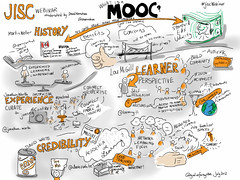
Image
What is a MOOC? by giulia.forsythe
Enhanced by Zemanta