Showing posts with label PLD. Show all posts

Thursday, November 8, 2018

"Coaching and mentoring happens alongside people..."

A lovely overview from Sarah Whiting, about what coaching and mentoring is...and isn't, and a couple of the options available through CORE Education.

The description from the Edtalks site reads:
Sarah Whiting, facilitator for CORE Education, discusses the role of coaching and mentoring in teaching. She talks about how important it is that coaching and mentoring happens alongside people, providing support in a safe, confidential and non-judgemental space. Sarah explains how coaching and mentoring has two different options for the way it may work in schools. One as an external partner, providing unbiased and sometimes different points of view, and the other where a school may want to develop a coaching and mentoring relationship that helps them to make changes from within the school's existing structure. Sarah discusses the different ways schools can use the coaching and mentoring support offered by CORE and how important it is that schools build their capacity in this area to become their own coaching and mentoring community so that the skills become embedded in the education system.


Thursday, February 22, 2018

What's in a question...?

Questions are part of our everyday lives, and it’s a challenge to communicate without them. If you have ever played those games where you have to communicate without any questions you know what a fundamental role they play. There are many types of questions, each of which has a different purpose, including (but not limited to) probing, elaborating, clarifying, and planning.
Coaching questions tend to have particular characteristics, and a good coaching question has the power to support a coachee in a range of different ways. Well-framed questions can positively stimulate thought, motivate, inspire, and help your coachee recognise their own strengths such that they remain motivated, energised and focussed.
I will now discuss some of the characteristics of a ‘good’ coaching question, but not before emphasising that effective questioning goes hand-in-hand with effective listening.
Effective coaching questions are:
  • Mostly open: Questions that start with, for example, “what”, “how”, or “if” and provide opportunities for a ‘wide’, sometimes surprising, response from the coachee.
  • Focussed on solutions: The coach supports the coachee to explore underpinning  frameworks that are influencing how the coachee considers an issue. The questions help the coachee identify options in a way that expands their thinking and ways of working (e.g. “What would you like to accomplish?”, and “What do you think you need to do to get a result that will work for you (or closer to your goal)?”).
  • Neutral: Do not contain any elements of the coach’s reaction, opinion, or concerns (e.g. “What do you feel?”).
  • Simple, short, clear and one at a time (with plenty of silence and space): Enables the coachee to focus on their thinking and ideas, rather than trying to figure out what the coach has just asked (e.g. “How could you appropriately communicate your point of view with the rest of your team?”). Multiple, rapid-fire questions can also interfere with the flow, and should be avoided.
  • Motivating: Focus on the things a coachee might do to move toward identifying and designing their own strategies and solutions (e.g. “What if you knew the answer? What would it be?”).
  • Have a positive effect on coaching outcomes: Questions that help the the coachee be creative to think of ideas and solutions that they may not otherwise have thought of (e.g. “If anything were possible, what are five possible options? What else?” And “What could you do differently?”).
These questions also map onto coaching roles, although they are not exclusive to those roles. As such, they may involve some of the following:
  • Investigator (knowledge): Who, what, when, where, why, how . . . ? Could you please describe . . . ?
  • Guide (comprehension): Would I be right in thinking...? What did you understand from...?”
  • Neutral inquirer (application): How do you feel X is an example of Y?; How would you say that X is related to Y?; Why do you feel that X is significant in your context?
  • Investigator (analysis): What are the identifiable aspects of . . . ? Would you classify X according to Y?
  • Investigator (synthesis): What are your thoughts around solutions for . . . ? What would you infer from . . . ? What are your additional reactions to . . . ? How might you go about designing a new . . . ? What could happen if you added . . . ?
  • Advisor (evaluation): What do you think about trying . . . ? What is the most important outcome for.. . ? Which would you say are the highest priority for . . . ? What would help you decide to . . . ?
Coaching questions will only really be useful if you try them out. This will provide you with opportunities to reflect on whether you felt your questions were well put together, and if they positively impacted the way your coachee was thinking. You should also consider if any of your questions were not really suitable for coaching (such as those that are closed, leading, contain your opinion, are multi-parted or wordy and difficult to understand). Effective questions are key to a coaching relationship; however, being able to craft a good question takes practice. The more you actively listen, and the more you hone your questioning skills, the more powerful the experience will be for both you and your coachee.


Image: Questions. CC ( BY NC SA ) licensed Flickr image by Tim O'Brien

Monday, July 22, 2013

Balancing professional development for teachers, with funding, and student achievement

In this podcast (that was shared by Mike Preece), some key points arise about providing learning opportunities across all sociocultural groups in New Zealand...in particular those who are facing socio-economic disadvantages. The link between provision of professional development and shifts in student achievement are discussed, and it was recognised that it is tough to demonstrate this shift using standardised tests. The link between lifts in achievement are not easily measured, and it is problematic drawing a direct causal link...especially as school are inundated by initiatives.

It would be great to hear your reactions - do you feel that use of achievement data to apply for funding "constrains and controls" teaching and teachers? Should we go back to assessing "the performance of individual teachers"? What do you feel the key aspects are that improve the learning experience for students in schools? Should the requirements for entry to teacher training be raised? Can Board of Trustees carry out "trusted" performance appraisal?
How good are our teachers and does it matter? Radio New Zealand's education correspondent, John Gerritsen discusses the quality of school teachers with Angela Roberts, president of the Post Primary Teachers' Association; Dr Judith Aitken, a member of the committee that reviewed the teachers council and a former head of the education review office; and Professor Dugald Scott, a former dean of Education at Victoria University of Wellington (source).
Duration:  27′ 54″
Image: 'Balancing on the Invisible' http://www.flickr.com/photos/36543076@N00/325661568 Found on flickrcc.net
Enhanced by Zemanta

Sunday, September 30, 2012

Learning in the 21st Century: A 5 Year Retrospective on the Growth in Online Learning

English: Diagram of technology-empowered profe...
English: Diagram of technology-empowered professional development for teachers. (Photo credit: Wikipedia)
This is report you may be interested in (recommended by John S Oliver). It is from a USA-based study (but the tends are likely to have some relevance to you) that analyses and reports key findings from 416,758 K-12 students, parents, teachers and administrators. The Speak Up team mention that by "comparing the issues we reported on in 2007 with the online learning headlines of 2012 we can easily see an increased experiential sophistication around different implementations of online learning as well as a new blending of emerging technologies such as mobile learning and digital textbooks into our online learning discussion" (source).
Key trends highlighted by the Speak up team from the report include (source):
    • A majority of teachers, school site administrators and district level administrators now report participating in an online class for their own professional development. For teachers, this represents a 148 percent increase since 2007.
    • Teachers’ value proposition on online learning for their own professional development is directly related to their previous online learning experiences as a teacher or in an online training class. 30 percent of teachers say that online PD is now their preferred approach for continuing education.
    • A new, positive correlation exists between educators’ experiences with online learning and their interest in mobile learning in school.
    • The profile of a typical student interested in taking an online class today is a middle school girl who values the use of a mobile device in school and sees online learning as her ticket to a more personalized learning environment where she is in control of the learning process.
    • One-third of parents now support increased investments in online learning.
You can download a free copy of this report via these links.
Enhanced by Zemanta

Monday, June 11, 2012

Stephanie Bader opens the "Curtain on Lurking"

This thoughtful, honest reflection about moving from a lurker to a more confident community participant was shared by Diana Ayling (here). In her post Stephanie Bader, reflects on the fear she faced when initially jumping into the development of her personal and professional learning network, and the steps she takes from a fearful first (and abandoned) attempt, to a fully fledged active member of social networks. It is reassuring to read Stephanie's account, and she also offers some great tips for folk who are just lurking in the wings, wondering how they might confidently take a meaningful part in the performance on the main stage.


Opening the Curtain on Lurking was written and posted by Stephanie Bader on May 18, 2012 in Global Communities of Inquiry13 comments

Act One. The scene is a large conference room. Laptops and iPads litter the tables that stretch from one end of the room to the other. Black power cords snake vine-like over and around the men and women in numerous chairs. They seem to wriggle out from the floor and the table legs and the leather attaché cases, in search of outlets.

At rise, we meet our subject of interest, seated back left, third row. She is by no means a principal character, but merely plays a small part in the intricate backchannel chat ballet that will unfold the moment the presentation begins. She positions her fingertips, poised to weigh in on the discussion, and much to her dismay, the stage fright sets in. Without so much as a keystroke, she slinks into the scenery and then disappears out the backstage door.

Act Two. Three months later. Ditch the conference room, keep the laptop. Add an active Twitter account, a handful of posts on her newly-launched professional blog, and a healthy dose of confidence. Our lowly player has catapulted herself into a more noticeable role in a learning community that is a living, breathing protagonist in its own right: defining and redefining its character with every click. She is replying to discussions within her online learning communities, she is writing blog posts, and she is transparently sharing her successes and failures as a learner and as a teacher. She is even starting her own discussions that — to her genuine shock (and secret pleasure) — have elicited responses and taken on a threaded life of their own, leading to others learning from and with her.

With this, her eyes are opened and her approach to the role she plays in this ensemble is no longer self-centered, riddled with worry about sounding uninformed or being cast aside as useless. Now, she sees herself in the part she was truly born to play, a role into which she has been written and with which many can identify. She is connected to every other player in a way that allows her to be a source of knowledge as well as an active participant in the shared learning that occurs.

But, with newfound confidence and involvement comes newfound respect and, consequently, responsibility. Eager, she volunteers to write for the Voices From the Learning Revolution blog. I have credentials, she says. A backstage pass. Experience. A writing degree. I can do this, she says. I have found my voice.

And then suddenly it arrives. The stage fright. Again.

It’s me, Stephanie

Our player is me: Stephanie, a second-year fourth grade teacher and novice player on the teacher-tech stage. I could be any one of the many teachers on a similar journey toward becoming connected educators who value life-long learning not only for our students but ourselves. I would venture to say that we all experience bouts of stage fright at some point in our careers, from directors to actors to understudies. It is normal. Expected, even. We ask ourselves the same questions: What do I have to offer that someone else can’t supply? What good will my opinion do? Hasn’t my question been asked countless times before?

At first, these questions were left unanswered. This collaboration thing was hard. I was plagued with Lurker Syndrome, and I resigned myself to thinking that I’d spend the rest of the year watching and waiting, letting this valuable time slip by without taking advantage of what was being offered. Soon, though, through conversations with educators in my PLN, answers began to surface.

Aren’t those teachers smarter than I am? (Some are, of course.) Won’t they fare just as well without my input? (Maybe, but they’ll be better off with it.) Who will benefit from what I have experienced? (Give it a break; no way to be sure, but someone will!) I began to realize that the journey toward connectedness, toward incorporating technology into my curriculum, has not been about the fear itself, but about how to overcome it, and furthermore, how to help others in overcoming it and fully transitioning into the 21st century educators we were written to be.

I am still faced with stage fright time and time again. But the professional relationships that I have cultivated with those who have a wealth of varied experience, and the conversations that have ensued on Twitter or other online communities, have given me the tools to confront it, to understand it, and to transform it into the kind of learning and teaching that effects change, promotes transparency, and showcases successes and failures.

Finessing the fear factor
Through several conversations and interactions, I know that some of my colleagues—both in my school and in my PLN–are still struggling with the stage fright. How to stand up to it. How to move past it. And surely there are many other educators who have entered this brave new place called “connected community” with some trepidation. Allow me to share what I have learned in hopes that it helps you to forget the heat of the spotlight and the pressure of a large audience (however difficult they are to see beyond the virtual footlights).

Start small. And this is true, even if the work you’re there to do is almost done. It is never too late to jump in and it is never too late to learn. In September, when I started on my road to connectedness, I was bombarded with email notifications containing links to discussion themes that in some cases baffled me. I shut down and repeatedly hit delete. I rarely spent time in the community discussion space and certainly was not an equal participant in our shared learning. My presence on Twitter was weak at best. Sound familiar? Try this: pick one. One discussion thread. One task. One tool. Something that appeals to you. That sends that tiny spark. That makes you think twice, if only for a second. Click over. Read. Write. Ask. Reply. Reply again. Trust me when I say that it will be liberating and exhilarating and will give you a sense of worth as contributor of experience, advancer of knowledge, agent of change.

Gather support. I didn’t even know what PLCs and PLNs were in September, let alone did I cultivate and contribute to one. (They are “professional learning communities” and “personal learning networks,” by the way.) And now, I am not sure how I’ve survived these several years without them. Within these communities and networks, look out for the friendly faces (or avatars). Our Voices editor, with his nudges to get writing, did not let me off the hook, even when I made the excuse of being caught off guard by stage fright and wanted to give up. A fellow Voices writer (Patti Grayson) offered her encouragement and direct support in the comment thread of a blog post we were both following. It happened to be a post about not being afraid to share. These are merely two examples of many that showcase what we can do—together. They are more than just a pat on the back. They are guideposts that seem to say, “I’ve been there. Others have been there. I’ve seen what happens when you get to the other side. Got your back. Don’t give up.” When I find something more valuable than that, I’ll let you know.

Keep going. In order for the two previous bits of advice to work, moving forward is a must. It takes precious time. And it is hard work. But the feedback, conversations, relationships, and changes that take hold are worth every minute. Make an effort to build upon the simple steps it takes to start. Try new things often and seek support to help you through the learning process. There are many people in every connected community (I am assured by veterans of this work) who are just waiting to help, yearning to offer guidance and share their experiences, and eager to get you to peak performance.

This brings us to Act Three. We’re not the same characters we were when we started. Our roles are being written and rewritten, constantly shifting with each new thing we learn and bring to our teaching. Whether you have been center stage, playing your part convincingly for quite some time now or whether, like me, you’ve been waiting in the wings and are just moving to the edge of the spotlight, there is always time to own your role and deliver your lines.

There is no excuse for stage fright now. In the world of connected educators, Time is always on our side. The learning curtain has yet to close. In fact, it never will. The crowds are cheering and we’re stepping toward the front of the stage.

Monday, December 5, 2011

Understanding the reasons academics use - and don't use - endorsed learning technologies

Fruit with flying seeds (Hieracium sp.)Image via Wikipedia
Gregory Kennedy, Deb Jones, Dianne Chambers, and Jon Peacock started their presentation with a wee cartoon that pictured a person in front of a computer that read "either there is an error, or you are too dumb to use this computer". This introduced the research project that the team has undertaken around the question "What are the drivers of technonolgy use in teaching and learning at the University of Melbourne?". Shannon and Doube (2003, 2004) identified a list of barriers impacting the uptake of technology, and this has been extended by Birch and Burnett (2009) - reasons are categorised as institutional, individual, and pedagogical.

Gregory introduced some of the internal University tools available (Blackboard, Moodle, Turnitin, Echo etc), but these enterprise systems were then being extended by 'unsanctioned' technologies freely available on the Web. The team undertook a survey with staff, and the quantitative data was reported on. The survey was completed by 268 faculty members, and the demographics were unsurpising. Some of the trends in what they found included a high percentage of faculty used the institution LMS tools, followed by about 50% plus using things such as Turnitin, and then 60% and up of staff who have never used the institution tools...some of which they didn't actually know about. The non-University-based technologies included onlined video (48.4% using them). Interesting that one of the areas where they could make the comparison was the blog and wiki tools. In an area where people are not using many of the more advanced social media tools, there is a rough equivalence between institutional and non-institutional tools.

Polski: LOGO LAPTOPImage via Wikipedia


There are a number of reasons for people using technology, especially value for students. Using a factor analysis the data was analysed and the reasons for using the technology are innovation and learning, and the sencond factor was the convenience. For not using, the reasons included support and skills, and relevance and value where there were concers about how relevant it would be for both staff and students. The four scales were put through a cluster analysis which pulled together all areas that were 'alike'. There were four clear set of staff that emerged - Regular citizens (n=41)not strong dirvers for technology); Convenience driven (n=37) most value in the ability of technology to make things more convenient; Perfect citizens (n=72) not that driven by lack of relevance, motiavated to use technology based on value, relevance etc; Dedicated warriors (n=95) similar to perfect citizens are in it for the right reasons but still have another of concerns; Disgruntled pragmatists 9n=17) dominated by the reasons not to use technology.
Warrior (comics)Image via Wikipedia


"Although technology is now commun place in most higher education institutions - most institutions have invested in a...VLE and employ staff dedicated to support eLearning - there is little evidence of significant impact on teaching practice" (Blin & Munrol, 2008).

Time is a huge issues for staff. Strategies need to be developed to encourage more faculty to invest time and effort, and one of the key factors identified are professional development.

Some interesting findings - it would be interesting to hear how the findings from the data have been used. At the moment they have been sent through to the academic board at the University, and this will then go foward into practical strategies to tailor PD programmes in response to that.
Enhanced by Zemanta

Wednesday, November 23, 2011

Teaching as inquiry...continuing to learn

P questionImage via Wikipedia
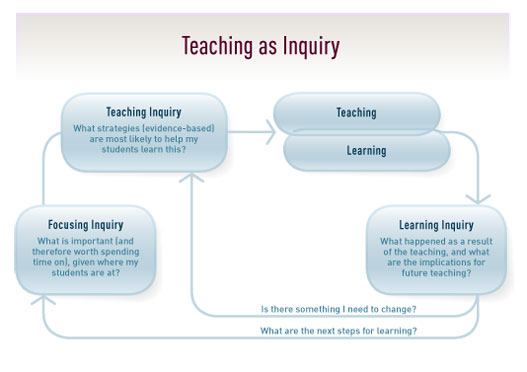
Christina Ward facilitated a webinar today - 23rd November (access recording here), which explored the topic of teaching as inquiry. A record number of people registered for the session, and even before the session got underway there was some good discussion in the text chat box. Christina, since 2004, has been linked up with the curriculum development team within the Ministry of Education (MoE), and since then she has been working on the NZ curriculum online.

The session started with Christina sharing a quotation by Stoll, Fink & Earl (2003): "Teachers are at the heart of school improvement, and with all the change in the world and new understandings about learning it is essential that they too keep learning". Christina stressed that it is important to have teachers at the heart - and thinking about learning. During the session Christina planned to give a quick look at teaching as inquiry and its place in the NZC, as well as characteristics of schools and classrooms where teaching as inquiry is evident along with some examples.


Christina started with a short survey that asked participants to rate their experience about teaching as inquiry. The results were really interesting with 20% of participants just beginning to learn about teaching as inquiry, 40% who have made a start and are noticing shifts, 30% who are confidently using teaching as inquiry, and 1-% who have a deep understanding and notice significant shifts in student achievement and teaching practice.

The teaching as inquiry cycle was then discussed, along with a clarification that inquiry learning and teaching as inquiry are different things. The teaching as inquiry approach has been developed to encourage teachers to inquire into their own teaching methods, assess its effectiveness, and learn or alter practices where necessary. Christina provided a really useful link to the Instep site that provides some great ideas of different ways that inquiry can happen, and it also explains some of the key terminology.


Education Reform I found this picture at: http...Image via Wikipedia

Participants were asked to watch this video where Helen Timperley, Professor of Education at The University of Auckland talks about ways teachers can gain knowledge through cycles of inquiry into their practice. There was also a link to a report written by Helen Timperley that covers the subject of PD in depth and what is proving effective.


The characteristics of schools who are showing that they have a pretty strong handle on teaching as inquiry include support for teachers with:
  • systems and processes for introducing teaching as inquiry
  • promote a culture of trust and open mindedness
  • allow for fallibility
  • encourage persistence
  • meeting in groups to understand processes and put them into practice
  • investigate data
SuitcaseImage by Mamboman1 via FlickrIn schools where inquiry teaching is encouraged the dialogues around teaching and learning have been seen to have changed, and this has proven healthy in whole schools shifts. A couple of participants mentioned aspects of teaching as inquiry in their institutions including: "We had teaching as inquiry projects as part of our appraisal process", although others mentioned "Some teachers use avoidance tactics such as this is an add on rather then it is something that we do every day in our teaching ", and "Often senior managers see it as an add on and a tick box exercise to keep ERO happy".

On the example front, Christina shared some awesome resources including the following videos:
TrustImage by gorbould via Flickr

And an article in .pdf format entitled Teaching as Inquiry: One School's Approach. Participants were able to pick and choose a resource that was relevant to them, go away to access / watch it, and then return to the Webinar...with comments. Some of the comments included:

  • "I love the idea of ‘de-privatizing’ learning. The importance of collaborative discussion of one anothers practice- It requires a very positive, encouraging environment for teachers to share so openly."
  • "Carol jarrett's comment about reframing the learngin conversation between teachers to look at problems of practice in a positive way so they can feel safe to try new things very very important"
  • "principals/leaders to model the inquiry is indeed powerful"
  • "Good to see the work being done in pastoral component with secondary school. It would be interesting to see the research"
  • "As DP I'm inquiring into eportfolios"
  • "Carol Jarrett's video says interesting things about taking those risks"
These comments blossomed into a really lively chat session, with lots of ideas and sharing of practices. It is well worth visiting the recording of the session to review what Christina covers, and also to have a good look at some of the conversation.

TrustImage by m-c via Flickr

Enhanced by Zemanta

Wednesday, April 13, 2011

A guide for teachers and those faciltiating PLD: ICT Transforming Education

This practical guide has something for nearly everyone involved in education, including teachers, principals, deans, and policy writers. As well as strategies for integrating ICT enhanced learning and teaching into curricula, the guide also has a variety of resources and ideas, which "in the hands of good teachers, may bring about profound changes and so transform education for ever" (p. 2).


ICT Transforming Education

Tuesday, November 9, 2010

E-pilot - Enhancing students' literacy with ICT

CHIPPENHAM, UNITED KINGDOM - FEBRUARY 23:  A s...Image by Getty Images via @daylifeThis Voicethread provides an overview of an e-Pilot  project with eight primary and secondary teachers that focussed on how digital content might assist in meeting the diverse literacy needs of their students.

The Voicethread gives and overview of all the initiatives being implemented by the teachers, the impact on their students' learning, and reflections from the teachers on their experience of being involved in this type of Professional Learning and Development.

The organisers and teachers would welcome your comments and responses recorded directly onto this Voicethread.


Enhanced by Zemanta

Thursday, October 7, 2010

Virtually Engaged! Building Virtual Professional Development Communities

This is the Prezi I developed to go with a presentation I gave at Shar-E-Fest. The Prezi resource was designed to be used as a presentation at the 'top' level, but if you look closer, and drill down (a bit like a treasure hunt), you will find heaps more detail. Have fun!!!

The abstract reads as follows: "Current models of Professional Development (PD) provision are being evaluated. As a result, one of the mainstays of education intuitions, the generic workshop, has been identified as having number of fundamental flaws. Hand-in-hand with this is the request by teachers for increased PD to help them with ICT Enhanced Learning and Teaching (ICTELT) projects. The Virtual Professional Development (VPD) Model has been developed in response to these factors. VPD is based around a community of learning, with a goal to provide peer-supported PD around ICTELT.

There are currently ten tertiary, secondary and primary school teachers from a variety of locations ranging from Kaitaia to Canterbury involved in this pilot initiative. The national facilitator works with these teachers to develop their own highly-contextualised learning plans. After an initial face-to-face meeting the group now meets regularly using the Internet based webinar tool Adobe Connect to share skills, experiences and ideas and to enable peer mentoring relationships to build. Facilitated sessions are at a time and place which is flexible to each teacher\'s needs. These exchanges are complemented by interactions within a social networking space (Ning), as well as through access to their own \'sandpit\' courses in a learning management system (Moodle), where they have the opportunity to experiment and try out skills before going live with learners. Skill-sets and experience vary in the VPD group, and this is offering great opportunities for participants to take on facilitator and learner roles.

The main factors that are becoming apparent from the evaluations to date is that the VPD model could be effective for future PD initiatives. However unlike generic workshops, VPD is mainly 1) about affective factors - community, belonging and relationships; 2) a personalised, contextualised curriculum; and 3) an experience where upskilling takes second place to a teacher\'s own learning \'journey\' which is all about their identity as educators and their beliefs about learning."


Please cite as: Owen, H. (2010, 27-28 September). Virtually Engaged! Building Virtual Professional Development Communities. Paper presented at the Shar-E-fest Conference.