Showing posts with label broadband. Show all posts

Thursday, July 5, 2012

Scoop from Edsurge: One thing every school needs to make it work - great bandwidth

Fresh off the digital 'press' from Edsurge (thanks to Betsy Corcoran and her team), is the (audacious) educationsuperhighway. The article really caught my eye as the initiative in the US seems to have several parallels with the Ultra-fast and Rural broadband initiativesin New Zealand. While there are also some big differences, there might be points that could be learned from, such as "templates...[that] show schools how to ensure that they distribute that bandwidth effectively throughout the schools, as too often connectivity shrinks at the campus threshold".
The overview from Edsurge reads:
There's one thing that every school needs to make it work: great bandwidth. Reports suggest that connections exist but too often connectivity is simply not reliable enough for teachers to count on it being available. Now serial entrepreneur, Evan Marwell, hopes to solve this problem. "My end goal is that every school has 100 Megabits per second," he declares. And yes, he's counting all 100,000 or so public schools in the U.S. To take on this audacious goal, Marwell is creating a 501c3 called EducationSuperhighway and a three-step plan. Get the full scoop here.

Image source
Faster broadband is coming - Ministry of Economic Development

Thursday, January 12, 2012

New Zealand's proposed Network for Learning

At the end of 2011 Rachel Roberts reported on an important meeting that she attended in connection with the New Zealand Network for Learning initiative, which will "progressively from 2013, ...provide schools with affordable, safe, ultra-fast internet access as well as a range of online content and centrally-procured services".

The VLN Community met with Marg McLeod, Acting Group Manager, Curriculum Teaching and Learning, and Eddie Reisch from the MOE. The image below illustrates some of the fundamental underpinnings of the Network that Marg indicated will include changing patterns of educational provision and more informed parents, communities, and then general public. The Network will be the channel for education content and service delivery and this will have major implications for the way the Ministry and other agencies deliver content and services to schools.
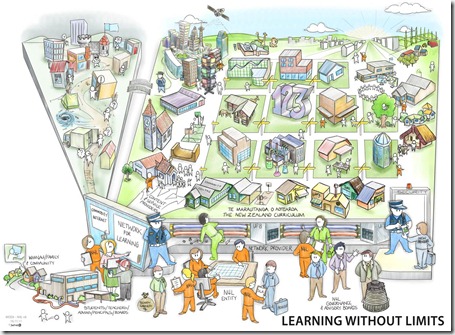


Some of the expected benefits are:
  • more equitable access to online learning opportunities
  • more effective sharing of resources and knowledge
  • reduced ICT complexity and cost
  • increased operational efficiencies
  • improved connection and collaboration between learners, teachers, school leaders and school communities.
  • opportunity to move to more modern learning environments that support 21st Century education delivery
  • lift in student achievement through greater engagement driven by innovative approaches to teaching and learning
Enhanced by Zemanta