Showing posts with label Learning Theories. Show all posts

Tuesday, January 22, 2013

The Problem Finders: Design Thinking for Genuine Epic-Scale Problem-Based Learning (Ewan McIntosh)

I have seen and heard Ewan McIntosh speaking on many occasions, but all on videos or podcasts, so I am really looking forward to seeing him live in this keynote session. The description of the session reads:Project-based learning has been let down in too many instances with “fake”, academic, theoretical problems that need solving. The learning processes involved are at best fuzzy for most educators: what is “collaboration”, “student-designed” and “student-led” learning?
  • See how research on great learning blends with creative practice to open up new exploratory, student-led learning.
  • Learn from the creative practices of some of the best media and tech companies in the world, with whom Ewan McIntosh has spent the past five years. What makes creative people creative?
  • Find out what the independent and collaborative learning skills and processes these growing creative industries, and other business, require. (source)
Nouvelle affiche Dada 2.0 - 200811posterdada.jpgEwan started by admitting that he is nervous because many of the thought leaders he follows are here! He points out that there is a mix of business, academia, schools sector etc, which, in part makes it quite a challenge. The presentation then moved to notions of success, and how we measure it. Is it money, happiness, the concrete 'outputs' they produce? Business feels they have nothing to learn from education, and education are not at all keen about being put within a business framework. Success is, in part the unpacking of mystery, into heuristics (gut feeling that something works), and synthesising our own 'algorithm' (up front awareness of what those heuristics imply, and what we need to do to build on them). Agents provocateurs are essential for creativity. And making learning whole is essential...what is the point of the learning? What are the goals? Ewan said that one of the reasons that he learned French was to meet French girls; and he did - he is now happily married and have three children! Ewan suggested that challenge is important for learning. Another key factor was collaboration; there are no things around, even jeans or a shirt, that don't represent collaborative effort (as opposed to team work). Responsibility and respect are also necessary for learning. Young people also want real things they can get their teeth stuck into. "Worksheets are really boring".  A couple of very entertaining examples were presented to show how 'irrelevant' and confusing many worksheets are. You can pretty much pick on any subject and find these pseudo problems that are totally out of context, and not at all experiential. Choice is the final, and the most important aspect of successful learning. Do your students always have between 3 and 20 choices when they are learning? The curriculum is the first thing that is cited as a reason that choice can not be given. Ewan asks "have you read your curriculum?". The duplication that goes on is often massive, so something like a learning wall can provide a creative way of removing the "repetition, conflict, and the stuff that is done again and again to no effect". There is less racing toward the clock. "Imagine a kids project defining your school mission statement" (Ewan gave the example of the Levi advert when they first started selling black jeans - "when the world zigs, zag"). [caption id="" align="alignright" width="240"] Nouvelle affiche Dada 2.0 - 200811posterdada.jpg (Photo credit: Abode of Chaos)[/caption] Ewan discussed four ways of thinking about how technology is often used in education. These were "Substitute - Technology acts as a direct tools substitute with no functional change"; "Augmentation - technology acts as a direct tool substitute, with functional improvement; "Modification - signififcan task redsign", "Redefinition - Technology allows for the creation of new" meanings.
Build in provocation and certainly don't come up with questions that are Google-able. You have to work quite hard to find questions that are not Google-able. Students can do the initial Google search on the answers that can be found online, and the rich thinking and learning happens around the (fewer) questions that are tantalising, and often personalised.
Drafting is very different that prototying. You build low fidelity prototypes - it happens really on in the research process. Handing the whole research process back to the students is important - take the teacher out of the picture. Empathising is the first stage. This is the stage where students jump in; they don't have to be taught the subject beforehand. Many things students already know a wide range of things and skills, the majority of which can be applied to questions and projects. Things such as 'master classes' for just in time learning, rather than just in case, which are optional, can also be effective.
Design thinking - "so what, who cares?" to test an idea. Research and practising skills, often with collaboration to 'pool' skills froms a wide number of resources. Taking time to analyse and evaluate is really important. And building confidence around these skills, ideas and thoughts are all part of the transformative process.
Ewan's talk had all the right ingredients: humour, stories, authentic examples, provocations, things to go away and think about, and some practical skills to take away.
Image - Nouvelle affiche Dada 2.0 - 200811posterdada.jpg (Photo credit: Abode of Chaos)

Ewan McIntosh: The Problem Finders from EDtalks on Vimeo.

Enhanced by Zemanta

Monday, January 14, 2013

30 Surprising (possibly controversial) research findings about how young people learn

In November, just before the Christmas madness, Tess Pajaron dropped me an email to share an article that focuses on how people learn based on a range of research. The writer explores 30 approaches, each of them drawn from current research (which is linked to so you can explore more if you'd like).
Although I may be a little tentative about some of the points and approaches covered, some caught my attention including 'Teaching kids at a very early age is counterproductive to their learning' and 'Engaging children in planning and reflection enhance their predictive and analytic capabilities'. The article opens as follows:


Have you checked your assumptions about student learning at the door?
People in general, hold onto beliefs that are shaped by early experiences, the media, and faulty influences. The following list is a compilation of research that may surprise you. Video games, e-books, playtime, and music are all a part of an educator’s repertoire.
You can read the whole article here: 30 Surprising (and controversial) research findings about how people learn

Image: 'J.O.Y | B.O.Y'. Found on flickrcc.net
Enhanced by Zemanta

Tuesday, March 13, 2012

Designing an ecology that supports students to be critical thinkers, engaged in problem-solving

The spaces that we exist in have an effect on our learning. When you are comfortable, the noise is low (or is the noise that you like to listen to such as waves breaking or music), the limbic system in your brain dials down the stress (fight or flight for example). Also part of the limbic system, the Hippocampus (required for the formation of new memories and the maintenance of cognitive maps) and Amygdala (performs a primary role in the processing and memory of emotional reactions) are more likely to be engaged if you are comfortable (physically and emotionally). So, the spaces in which you learn are important.

These are a couple of engaging resources that talk about learning spaces. The first is a TED-x video entitled Re-imagining Students As Agents Of Change. The speaker, Christian Long, gives some examples from his experiences with people in different environments and how they influence the ways they, and we, think, act and interact.
.

It was great to see an online article (recommended by DK) in Chicago Architect, which "featured Trung Le in a two-page article about his thoughts on the design of learning spaces. In it, Le discusses a number of projects he’s currently working on, The Third Teacher and trends he sees shaping the development of 21st century learning spaces" (source).

Trung Le is quoted as saying "Do you want your kids to be critical thinkers, engaged in problem-solving? We can design the ecology to support those goals", and  “If we want students to be engaged, we need to design the entire ecology to support that”. Have a read and see what you think - please leave comments below.

Tessa Grey also shared the following here: "Some of you might be interested in the open learning spaces blog hosted by Chris Bradbeer (Associate Principal in Auckland), embarking on a research masters program on the subject of pedagogy and classroom spaces). He writes",
If you’re in the Auckland area you may well be interested in theOpen Learning Spaces Professional Learning Group. The idea is to bring together teachers and leaders who are interested in open/ flexible/ innovative learning environments on a termly basis to investigate the opportunities and challenges that they present.

Tuesday, December 6, 2011

Scholarship, leadership and technology: A case study of embedding evidence-based practice

English: Glasgow Caledonian University new logoImage via Wikipedia
Linda Creanor opended by highlighting some of the issues that they are facing in Scotland. They have been inspired by examples from around the world and taken them back to their own context where they have been adapted. Linda is based at the Glasgow Caledonian University which is a post-92 institution, with 17,000 students, and 3 academic schools. There is a stong emphaisi on learning.
Some of the challenged include:
  • Maintaining staff engagement in the innovative learning and teaching
  • Career progression seems to focus on research rather than expertise in learning and teaching
  • The changing nature of learning and teaching due to technology advances is not always underpinned by pedagogy
  • There are pockets of excellence but making sure that they are mainstreamed is a challenge
  • Need to link various aspects of CPD, scholarship and technology together,and all with increasingly limited resources
Leadership is key in transformational change alongside change agent roles (Chapman, 2002). They came across the distributive leadership model (Lefoe, 2010)  "a dsitribution of power withing the sociiocultural context of universities and a sharing of knowledge, of practice and reflection through collegiality" (lefoe, 2007, p. 5). These ideas were then used to develop GCU's CPD framework for learning and teaching, and this was launched in 2008.


The Caledonia Scholarships and Associates model is competitive, peer reviewed, and supported by senior management. There is status attached to the roles and the criteria were linked to promotion. The projects are expected to be action research, evidence-based, and to embrace learning technology. This were influenced by scholarship (Boyer, 1990). There is minimal resourcing (2,000 UK pounds per scholar). The money the scholar gets could be used for conference attendence, or for data processing, for example.


Wanted to try to engage people in innovation, and provide opportuntiies for new and experienced staff to maintqain continuing engement with scholarly approaches to learning and teaching throughout their careers. Although they started with individuals, there are now small groups working together on projects.

Facilitation is through f-2-f meetings, an online community in BB, a blog, shared resources, methodologies and experiences.
English: Backstage Pass tour of the Metropolit...Image via Wikipedia


The findings indicate that the status and the role are as important as the project. Impacts include (over 48 associates over 3 years) 36 projects undertaken, minimal resourcing of a very effective initiative (including awards, promotion, and development of valuable research findings). "The Scholars and Associates Program has proved to be beneficial to participants in a variety of ways in the intiial phase" (external evaluator). There is continuing support, and growing evidence of scholarly activity. It appears to be a sustainable, cost-effecitve model. In the future they are moving toward strategic focussed - such as a new role of Caledonian Fellow has been approved by Senate and is under development.

Enhanced by Zemanta

Tuesday, September 13, 2011

The Learning Powered School

21st Century educationImage by wlibrary via FlickrGuy Claxton today facilitated a webinar entitled The Learning Powered School. One of the first things he started by asking was why is it that the 19th century approach to learning and teaching is so 'sticky'. He suggested that few people disagreed that education in some way needs to change, and proposed a vision that suggested 21st century education needs to help you people to learn to be open-minded and inquisitive, while also discovering their passions. They should also be encouraged to make and repair friendships, enjoy seeing different sides of a subject, and be unafraid of uncertainty. So, as far as the latter point is concerned this would involve the design of a curriculum that offers, regularly, experiences that are increasingly uncertain.

Guy cautioned against using the academic jargon often used in the writing of vision statements, which are as a result impenetrable and inaccessible to a large proportion of, for instance, government ministers. Values, he also feels should be relevant to life in general, not just for a test. Fancy language gets in the way of being taken seriously!

One of the key points Guy discussed was what does it take to so a 21st century education properly? He advised that eight core principles have been distilled from research:
  1. Broadening the core aims of education
  2. A vision that offers success for all
  3. A strong rationale
  4. Precise and accessible language
  5. Progressive change to school culture
  6. Focusing on teachers and teaching
  7. Honest self-appraisal
  8. Committed leadership
 Leadership he advises will really make or break shifts in practice, along with clear, visible endorsement by leaders that reinforces objectives. The traditional education agenda, he argues, will not be changed without strong leadership.

Having an 'and' mentality is essential. People who are looking at assessment scores can also be looking at key competencies, but it is reliant on having a complementary set of ways of tracking the key competencies. The government is not stopping us changing by the focus on assessment.

The way in which education needs to change is on a whole lot of different levels. Where the issues are now are in helping and supporting, primarily teachers, but also students, teachers, and members of the wider community how change is going to happen and what it will look like. Where the world is now is moving from "vision to precision", and it requires clarity around, for instance, the role of parents in their child's learning experience. Clarity will help address misunderstandings and 'fogginess'.


Enhanced by Zemanta

Tuesday, August 2, 2011

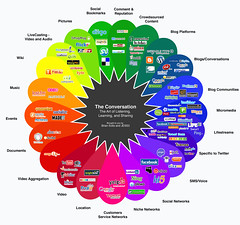
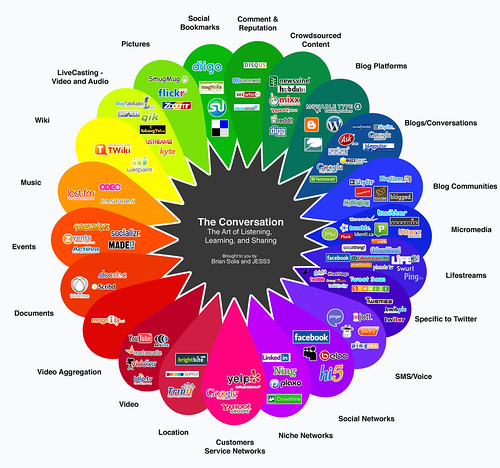
The conversation prism: Visual way of representing the networking realm

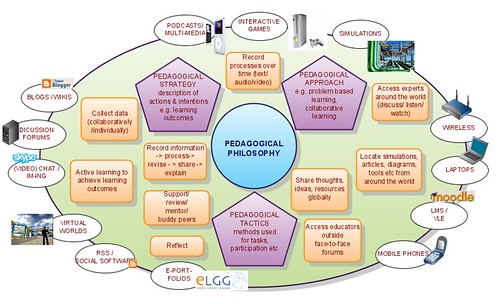
Sometimes, once you have worked through your design stages (and this could be for a whole programme or for an activity), you may then be left wondering what tool would be suit your needs, given the approaches and interactions you have planned for. You might, for example, have decided that you are going to use a problem-based focus and one of the things you would like your learners to do is access experts from all around the world. To do this you might encourage your students to access niche networks.


However - how do you work out the connections, and find out what is available? Bring on the following two diagrams: Pedagogical underpinnings to ICTELT design and The Conversation Prism. The first looks at some possible pedagogical approaches, and ties them with activities. The second outlines broad communications and interactions, and then suggests a few of the tools that could be accessed and used by your students. I've found it really useful...and it would be good to know if you have any examples or suggestions how you have used these tools :-)


To access this image full size please click HERE (by hazelowendmc)

To access this image full size please click HERE (by b_d_solis)
Enhanced by Zemanta

Tuesday, July 26, 2011

Truly integrated learning???

graph of quadratics with horizontal shiftsImage via WikipediaWe have all heard the discussions around integrated, cross-curricular approaches and project based learning. So what does truly integrated learning look like? This video caught my attention because the school really does seem to have integrated the learning of quadratic functions in a cross-curricular approach. The big questions for me are, how can this approach be extended across an entire school? And how are we going to attempt to assess it? (Current standardised testing would seem to fall far from the mark).

Concept map describing activities offered by u...Image via Wikipedia

The description of the video reads: "Integrating cross-curricular teaching of quadratic functions. At Henry Cort Community College it is not just the maths department that teaches quadratic functions. Indeed, teachers from the PE, design technology, science and IT departments all work together with their maths counterparts to teach the subject in a way that interests the students. Henry Cort, in Fareham, is a specialist sports college, so it seems natural to video basketball throws and use movement analysis software to plot the parabolic trajectories. In design technology the students build adjustable table tennis ball launchers and analyse the track of the balls. In the maths lesson, the students use dynamic geometry software to plot quadratic functions that match the flight of the ball, providing a feel for how the various coefficients affect the shape of the graph. Later the pupils go on to look at the science behind projectile movement". 

To watch the video please click HERE.


Enhanced by Zemanta

Friday, February 18, 2011

How do I set about designing a course in my Learning Management System?

Moodle on a Nokia 770Image via Wikipedia

I have been working on a process model and framework, adapted from earlier examples, that I developed to help answer the question “Where do I start?” for teachers who are unfamiliar with adapting education resources to make effective use of ICT Enhanced Learning and Teaching (ICTELT).

This video very briefly shows an example of a Moodle course that has been designed using the ICT Enhanced Learning and Teaching approach, as well as exploring a couple of the tools that could be used by teachers (hosted here).

Employing a scaffolded approach appropriate for working in small teams of teachers, or as individuals, the guiding questions of the ICTELT model form the foundation for collaborative discussion of design choices, and the incorporation of a range of pedagogical approaches with a variety of tools. The model and framework can be used with new and/or existing programmes, modules, units, sessions, or learning objects, but initially practitioners are encouraged to trial the process on a small scale.

Please contact me if you have any questions.

If you can't see the embedded video below or would like to access a smaller file format, please click here.


Enhanced by Zemanta

Wednesday, December 22, 2010

The Life Practice Model: a real life example

NEW YORK - MARCH 30:  A student reads on a dot...Image by Getty Images via @daylifeFor authentic student voice you can't get much better! In this video Colby takes us through his four years of his time at school, and describes what and how he has learned, and with whom.

The description on the site reads:
"Hear a freshman tell the educational story of the last 4 years of his schooling, from August 2006-May 2010, after his parents decided that traditional school wasn’t fully meeting his needs. Colby attended Turning Point Learning Center, an innovative public charter school in Kansas, utilizing 1:1 laptops, and Web2.0-infused Project Based Learning."


Enhanced by Zemanta