Showing posts with label ePortfolios. Show all posts

Tuesday, December 6, 2011

The CAT amongst the pigeons: A reflective framework approach to personalised PD in open, flexible and networked learning

Traffic lights can have several additional lig...Image via Wikipedia
This is an initiative designed by John Clayton and Richard Elliott (Emerging Technologies Centre). Richard Elliott started the session by asking the question "is there a difference between education and training?". He then used the scenario - "if you had a daughter would you prefer she was having sex education or sex training?". The Competency Assessment Tool is embedded in a reflective framework.

The CAT consists of 5 modules, and has been used with people in a range of countries. The tool has been designed to enable people to assess their current competency in a range of defined activities. The response is designed around 'traffic lights', and at the end you have a pictorial carpet. There are then 3 steps that take the individual through the entire process. An ePortfolio is required as evidence of competent practice.

The tool is adaptable and can be used by pretty much any institution. (http://etc.elearning.ac.nz). Richard demonstrated the tool live, and explained that the tool has been trialled such that the language is not ambiguous, for example.

It is an approach that empowers learners to assess their own competencies and progress. The tool can be used in the appraisal process for staff as well. At the moment it is in Beta form, and the next step is to put a database behind it. At the moment you have to print out the results afterwards.
Enhanced by Zemanta

Tuesday, September 6, 2011

Interested in ePortfolios? The International Journal of ePortfolio


The International Journal of ePortfolio (IJeP) is described as "a double-blind, peer-reviewed, open access journal freely available online". Subscriptions and fees are not required to access this journal; however, readers desiring hardcopies of issues can order them online.

The mission stated on the site of the International Journal of ePortfolio (IJeP) is "to encourage the study of practices and pedagogies associated with ePortfolio in educational settings. The journal’s focus includes the explanation, interpretation, application, and dissemination of researchers’, practitioners’, and developers’ experiences relevant to ePortfolio. It also serves to provide a multi-faceted, single source of information for those engaging in projects and practices associated with ePortfolio."

"A refereed (blind) peer-reviewed journal, IJeP embraces inquiry into ePortfolio in educational settings holistically; therefore, manuscripts considering the following areas of investigation are welcomed:
  • instruction and principles of learning that utilize and inform practical, effective ePortfolio methodologies;
  • evaluation and assessment methodologies and practices supported by ePortfolio;
  • case studies and best practices regarding applications of ePortfolio for learning, assessment, and professional development supported by scholarship of teaching and learning practices and research methodologies;
  • theoretically rich accounts of the principles grounding ePortfolio work and its relationship to larger social and cultural phenomena; and
  • innovative development and applications of technologies that enable new ePortfolio practices."

"IJeP employs a rolling submission process; however, those wishing to be considered for the next issue of IJeP should plan to submit their manuscript by December 1, 2011. Those submitting manuscripts to IJeP can expect the review process to take approximately 90 days."

the next four journalsImage by paperbackwriter via Flickr

Enhanced by Zemanta

Tuesday, August 23, 2011

Webquests and ePortfolios - both free :-)


The following resources were recommended by a member of an online community, John Oliver.


This Webquest site looks great. There are Webquests created and shared by educators from around the world, and covering a heap of different disciplines (geography, economics, history, culture, drama to name but a few). Each of the Webquests states the key focus and grade level, and everything is tagged for easy location of resources. You can also contribute your own.
The second resource is a free ePortfolio service - Foliji- which describes itself as "the easiest way to build your own folios (portfolio, website, webpage) and it provides both the structure and a template for you. It is a web-based software for creating folios in a short time without writing any HTML codes." There is also a handy, step-by-step "how to" video that shows you how to set up your own ePortfolio.


Enhanced by Zemanta

Thursday, February 3, 2011

A possible starting point for thinking about designing online courses???

Programme design for learningImage by hazelowendmc via FlickrThis presentation has been designed as a starting point for anyone thinking about online learning. It's a very brief overview that looks at some of the outcomes and interactions that might be desired, along with a tool that may be used to help achieve this (with careful learning design). It is not supposed to be exhaustive...more of an indication of potential and something that leads to more questions.


Enhanced by Zemanta

Wednesday, January 19, 2011

An uneasy dichotomy? How are ePortfolios being used in education?

Key stages of learningImage by hazelowendmc via Flickr
Trent Batson, executive director of The Association for Authentic, Experiential and Evidence-Based Learning (AAEEBL), provides an initial summary on the current status of global portfolios in his article: "Review of Portfolios in Higher Education: A Flowering of Inquiry and Inventiveness in the Trenches". The article indicates the variety of current uses for ePortfolios, and how they are assisting learners to develop digital literacy, communication, and writing skills. Reference is also made to the formation of The Fund for the Improvement of Post Secondary Education, and how it heralds the emergence of the field of portfolio studies. The article concludes with a recognition of the up and coming technologies for ePortfolios, as well as a comparison of course management systems and portfolios:


"course management systems, no matter the name, usually are defined by and focused on a course, which has a beginning and an ending. Portfolios are instead most often identified not with a specific course but with the learner over time" (Batson, 2010).

Dynamic interconnectedness: ePortfolios

This article seems to suggest that portfolios / ePortfolios are already taking on a lifelong learning purpose, with students taking them forward through their primary, secondary and tertiary education, and then out with them into the world of, for example, work. Two points spring to mind. The first is that ePortfolio use has not been around long enough in education institutions to show the level of flexibility and portability for a student to work through the school system and graduate with their own ePortfolio - owned by the student rather than the institutions where they are studying (partly because of issues with interoperability, policies, and standards, as well as concerns and tensions around using Web 2.0 ePortfolios). The second is, as far as I have witnessed to date, some ePortfolio use in education tends toward templates, and specific requirements. While it can be argued that requirements need to be made clear and students need to be scaffolded, how can this be translated to an ePortfolio that is structured in a way that is personalised, relevant to a learner's future, and useful to, for instance, future employers?

One of the comments that follows Trent Batson's article poses the question "Why do portfolios always seem to end with graduation?", and goes on to suggest: "Let's not continue to use portfolios just as a repository for student work. They can be more than that; make it an online space alive with activity, interaction, and connections" (Brian). This comment highlights the current uneasy dichotomy of assessment / lifelong learning; and assessment / creativity.

Perhaps, as the use of ePortfolios matures, then education will find a way to enable learners, while also fulfilling course requirements, and in turn encourage them to take their ePortfolio forward with them(??). But it may prove to be a long arduous road to reach this destination
Enhanced by Zemanta

Tuesday, November 23, 2010

Listening to Student Voice: Thinking about ways of improving schools

Student successImage by hazelowendmc via FlickrIn this Slidecast Nick Rate gives a brief overview of student voice in four areas:
  • student voice in reflections on learning
  • student voice in student led conferences
  • student voice in learning and school design
  • student voice in a democratic curriculum
Nick uses the following quote to sum up:

"What pupils say about teaching, learning, and schooling is not only worth listening to but provides an important – perhaps the most important – foundation for thinking about ways of improving schools." Rudduck, Chaplain & Wallace (1996).

You can visit Nick's blog post and read his thoughts and ideas about his presentation, and the topics covered there.


Enhanced by Zemanta

Saturday, July 31, 2010

Vocational education and training: Can ICT enhanced learning and teaching help?

WPA Adult Education (New Deal)Image via Wikipedia
The Vocation Education and Training (VET) Sector, for those who are not sure, "prepares trainees for jobs that are based on manual or practical activities, traditionally non-academic, and totally related to a specific trade, occupation, or vocation". In New Zealand the VET sector is in part serviced by 39 Industry Training Organisations (ITOs), as well as by Polytechnics, Private Training Establishments, and Wananga.
A couple of the key points that make it necessary to think creatively when considering ICT enhanced learning and teaching (ICTELT) and the VET sector include meeting the needs of these learners who will, like all learners, have a variety of learning preferences, but may also face literacy, language and numeracy challenges, and life and work commitments. These same learners are likely to also have a rich range of skills (both formal and informal) and need a way to capture their prior learning and experience (click HERE to watch a student speak about Recognition of Prior Learning - RPL). If  ICTELT is seen as a positive way of assisting learners to learn creatively, however, then these are also the students and trainees, who are likely only to have limited access (at best) to connectivity and technology. On top of all these factors is the culture that is often prevalent in industry where learning 'virtually' at a distance or in a blended course is perhaps not seen as feasible or effective (click here to download a report from 2008 around the New Zealand context entitled "Using e-Learning to build workforce capability: A review of activities", and for comparison a report about small businesses and eLearning in Australia in 2008).

Civil Engineer Students at Dubai Men's College
Nevertheless, times are changing, and with them is increased access to broadband (see for example the National Broadband map for NZ and click this link for an explanation why bandwidth is important), personal ownership and use of computer(s) and mobile phone(s) is increasing (click here to see the 2009-2010 statistics), a greater awareness that 'soft' skills such as critical thinking, as well as social and communication skills are as important as the key competencies required to be effective in a specific career.
Flexibility and meeting learning needs and preferences, while making learning accessible to as many people as possible are key factors, and ICTELT and well-designed blended and distance courses appear to offer the potential to work towards these ideals.
This resource provides links to a few examples and case studies of ICTELT use in VET, in particular from Australia where there is a massive initiative in this sector see for example the Australian Flexible Learning Framework who have a massive range of resources, events, research, case studies, reports, training and ideas). There are also links to a couple of associated research articles and tools. Please let me know if you have anything you would like me to include in this resource - I would be really glad to do so :-)

Community and learning

One of the most exciting examples of bringing together community and VET training in a culturally responsive way is the initiative trialled in 2009 in conjunction with the Garma festival (located 40km from the township of Nhulunbuy (Gove) in the Northern Territory, Australia at the Gulkula festival site. The festival theme was  Creative Industries, with four vocational foci:
  • Construction
  • Multimedia
  • Tourism - specifically tour guiding
  • Music
To listen to Roger Bryett speak at the Creative Indigenous Economies forum please click HERE (mp3 - 8.75mb).
To view the streaming video of Roger Bryett speaking at the forum about this initiative please click HERE
Image source
Other examples include (all from Australia):
  • 'Top End Groove' - a project that aims to establish a cultural tourism business and training network. The project aimed to develop and grow indigenous and cultural tourism businesses through the use of technology and eLearning by enabling knowledge sharing, improving access to skills training and creating a central point for promotion and marketing indigenous tourism. Click HERE to listen and find out more about the project
  • The Jobs for our Mob project was established to develop an e-training centre which incorporated technology to identify and deliver the pre-vocational skills required for indigenous people wanting to enter the mining, construction or engineering fields.Click HERE to listen and find out more about the project.
  • This case study, "Panel beating apprentices take to technology", describes an Australia-wide skill shortage in the automotive vehicle body repair industry first prompted Brisbane North Institute of TAFE todevelop a programme with training materials available on CD-Rom and online, thereby making a traditional industry area more technologically savvy.

Examples of online environments in the VET sector

Example home page designed for an LMS

ePortfolios

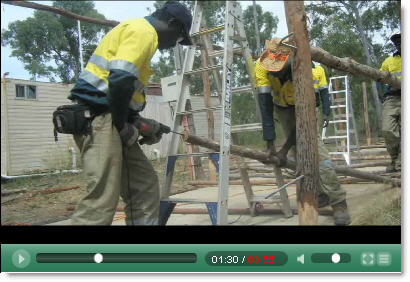
To view this video full size, please click HERE
An ePortfolio helps students with the identification, assessment and recognition of what they know and can do, and could include evaluations, comments, feedback and reflections from peers, managers, facilitators etc who have been involved in the applicants life/learning journey. The assessment, therefore, of what a person can do is from authentic sources, collected over time (click this link to access "Verification of a person's aualification e-portfolio use cases", and this link to access "Vocational Education and Training e-portfolio use cases").
The contents of an ePortfolio would be assembled over time, and could include some or all of the following:
  • Evidence of informal or professional networks regularly cultivated, contributed to, and participated in online and why these have been important / influential
  • Examples of ideas, thinking, innovations from the applicant that have been shared in communities (including online) and what comments, feedback and reactions were elicited
  • Illustrations of collaborative creativity, problem-solving and work (including with online contacts and communities)
  • Work samples  e.g. something the applicant has designed, created, done or written (including video records of processes, images of projects at various stages of completion, and a selection of images of showcase, finished pieces)
  • A record of  performance  e.g. video recording, reflections (audio/written), appraisals (audio/written - elicited and spontaneous)
  • Copies of any statements, references, images, video clips, audio, or articles about the applicant's employment or community involvement 
  • Documents which recognise the applicant's expertise, e.g. copies of licences, awards, prizes, membership of professional bodies - along with reflections / comments around these achievements
  • Evidence of training  e.g. copies of school reports, certificates or statements about education and training / outline of any course the applicant may have undertaken
  • References or letters / performance reviews from employers, work colleagues, clients, community leaders that link specifically to required competencies or elements covered
For a fuller list of resources around using ePortfolios to enhance education in general, with some examples relevant for VET, click HERE.
Hairdressing, a case study using Mahara
Examples of ePortfolio use in the VET sector include:

Multimedia

For a fuller list of resources around using multimedia to enhance education in general, with some examples relevant for VET, click HERE.

Support: Completion, retention and success

This report ("Student Learning Support Programmes that demonstrate tangible impact on Retention, Pass Rates and Completion") is a combination of summaries and brief case descriptions of some of the effective programmes and other support mechanisms that NZ Tertiary Learning Advisors (TLAs) provide for students in universities, polytechnics, institutes of technology, and other tertiary institutions (click HERE for the executive summary). Findings indicated that there were significantly higher course pass rate for students who used the programme (84.4%, compared to 69.8% for those who did not use the programme), as well as significantly higher final exam pass rates (71.6%, compared to 62.8%). Some of the strategies included the hosting of models, guides, examples and support in a Learning Management System (LMS) alongside personal, one-to-one support, and the use of an online skills survey. However, the main finding was that relationship and trust building, as well as recognition of learning preferences and cultural appropriacy, were key factors for success.

Assessing and assessments

Assessing and assessments can take many forms, including:
  • Facilitate and record a discussion within a trainee's community, where members of that community speak about the applicant
  • A narrated 'learning story' (recorded - audio or video)
  • Record an oral presentation for the assessor or assessment panel
  • Take part in a role play (asynchronously or synchronously - face-to-face or virtually; e.g. in Second Life)
  • Demonstrate knowledge/application of skills through a scenario with video/audio evidence recorded
  • Be assessed on the job with video/audio evidence recorded
  • Complete an online assessmen
  • Complete a project that is partly or wholly online, and possibly part of an ePorfolio
  • Have skills and knowledge attested to by an appropriate person, e.g. Kaumatua
Where multimedia is used there can be no question as to the authenticity of the event / process. Furthermore, there is potential for reliable evidence, when compared with a paper-based portfolio, of competency and application of the in required skills in 'real world' contexts.
Although there is no mention of ePortfolios or alternative ways of collecting evidence in these following reports, it is worth bearing in mind some of the principles mentioned: "Assessment of Learning in the workplace: A Background Paper", which can be read in conjunction with "A guide to good practice in ITO structures and systems for on-job assessment".
Enhanced by Zemanta

Wednesday, April 7, 2010

ePortfolios: showcasing student voice and choice (ACEC 2010)

Literacy...Image by hazelowendmc via Flickr
Christine Haynes - ePortfolios: showcasing student voice and choice

Christine showcased some of the work that students (reception to year 6) are doing with multmodal texts, digital storytelling, and ePortfolios. She shared some rich examples of student work and comments. Students used either their own photos or images from places such as the "Australian photo library". In addition, the class created the podcasts using their own voices as well as others from interviews.

Visual explanations were used a lot to encourage oral literacy. Students themselves created much of the resources and explanations too. Data was translated into graphs and charts, which were shared with and commented on by peers. Awareness was raised of audience and appropriacy as well as creation of resources for authentic audiences. As such the students created artefacts and images around concepts such as, for example, peace. Animation, and other hands-on creation were seen as really important.

Reflection was encouraged, and students were assisted in reflective practice. For instance, commenting on book chapters as they read them. Students were also asked to explain choices around images, colours and backgrounds. Parents could also visit the resources, and leave comments.

The link with Alan November's keynote was strong, with ePortfolios being populated by student created resources, which were then shared. The primary years examples shared were indicative of the creativity and engagement of learners once they are given the choice and forum to share.

Reblog this post [with Zemanta]

Sunday, December 13, 2009

ePortfolios: Recognition of Prior Learning and Communities of Practice


At the recent ePortfolio Symposium hosted in Melbourne and organised by Allison Miller of the Flexible Learning Framework, there was a great range of practical tips, and thought provoking presentations.

The blurb from the site advises: "More than 140 teachers, trainers, managers and ICT professionals attended the inaugural VET E-portfolios Showcase 09 (VES09) in Melbourne on Friday 16 October, either at the actual event or by participating in free online sessions, to learn from some of the most highly regarded e-portfolio researchers and leaders. Click here to view the full program."

I went to several presentations, and the notes were taken at two that I attended.


Annelieske Noteboom & Christine Cooper, (Challenger TAFE) - The ePortfolio Landscape.

A presentation about Recognition of Prior Learning (RPL), it was interesting that the presenters commented that more creative, flexible approaches to ePortfolios would be like having a cardboard box full of paperwork – as an RPL assessor you would never be able to sort through all the paperwork. She said that it was “all very nice to allow students to be creative, but it is not good to have students with an electronic ‘wheelbarrow’ full of stuff”, it needs to be organised". I certainly agree that every ePortfolio should have an element of organisation, and learners should be able to create different views from the collected and developed artefacts, planning, reflections etc. - one of which could be in line with RPL requirements, and easy for an RPL assessor to assess. The creativity is encouraged in the underlying learning and development, rather than, necessarily, in final ‘views’.

The presenters made another point around file consistency – but if the files are hosted online (and shared with only the assessor if privacy is an issue), then the files will stream, and this reduces problems with being able to view/listen to files.

Some initial reticence of participants to actually wear the camera glasses and talk their way through the processes they are undertaking. The camera glasses empower the learners though, as there is no-one there videoing them, but rather they take the video themselves, and if they are not happy with the result they can make another version…until they are happy with the result. Also have the ability to edit the video if they wish to…although I wonder if there are issues with verifiability if students are able to edit RPL videos? Does it matter? Would it not instead make it easier for learners to make sure, according to detailed rubrics that they are meeting requirements?


Gillian Hallan (Queensland University of Technology) - ePortfolio communities of practice: Local, national, global

This presentation (which can be listened to in full by clicking HERE) included highlights of the work that is required around sustainable practice and ePortfolios. Gillian also wanted to examine what was making existing CoPs work, and what stakeholders required to continue to make it successful.

The project started in December 2008 started with a literature review, and two AeP2 symposia and showcases. As part of this, ALTC was set up to as a group site, which includes an ePortfolio section. From March to July 2009 several research activities were undertaken along with a report around the research. Gillian made reference to Wenger’s definition of CoPs, before moving on to describing the CoP lifecycle, which goes through stages of inquire, design, prototype, launch grow and sustain, but many CoPs die just as they are emerging. The research Gillian was undertaking was around why some CoPs are successful, whereas others are not.

Some initial research findings suggested tat there was a 74% interest in a regional CoP, whereas there was a stronger (86%) interest in a national CoP, and reasonable interest in an international CoP (76%). Gillian mentioned that there are a number of communities formed around various aspects of ePortfolios, for example, there are some that are formed around supported learners through PDP (Personal Development Plans), and others that are formed around specific ePortfolio platforms.

The contexts for ePortfolio CoPs were: 1) pedagogy – 75%; 2) discipline based – 60%; 3) technology – 50%. Gillian went on to discuss the scope of collaboration for CoPs, in particular opportunities to collaborate, participate in special interest groups, disseminate information, and the develop further resources. Questions were posed around around whether an ePortfolio CoP should be organic or whether it should be managed. Almost 3/4 of respondents said that they felt there should be a funded CoP manager.

Some of the key factors for success that Gillian’s research identified were: “…our experience is that it needs a lot of mediation”; “Need a leader – need a community manager, without the work I do there is not a community “…a facilitator is critical – particularly around raising awareness”. The audience were surprised by the fact that a ‘manager’ was critical and cited social networking CoPs as an example of CoPs that are often not facilitated. Gillian then mentioned that respondents from the VET sector were much more in that social networking space, whereas many of the HE respondents were not in that same space – it did not form part of their day-to-day life. The large majority of the respondents in this research were from HE as this is the sector the research project was funded to support.

Success factors also included the fact that there needs to be a range of activities, and some face-to-face meetings can be refreshing. On the other hand, too much activity can be overwhelming and exhausting, and this is perhaps were a good facilitator comes in. Some of the main challenges identified included using the technology facilitator workload and community engagement. “Keeping engagement has been the largest challenge – feedback at events s generally positive but how” to measure the amount of activity?”. In a nutshell, there needs to be a balance. To achieve sustainability there are a range of internal and external drivers, including encouraging a broader interest in ePortfolios (e.g. employers), professional accreditation, cross-sectoral engagement, building, and extending national and international relationships.

Gillian concluded by saying that the final report will be a lot more detailed and will include a number of case studies that will present a richer picture of ePortfolio communities. In the meantime, it is important to continue to stimulate interactions and attract new participants, as well as a need to maximise the opportunities to build CoPs at the local, national and international levels.

Monday, November 2, 2009

A discussion: ePortfolios - how are they supporting 21st Century learners?

"A discussion: ePortfolios - how are they supporting 21st Century learners?" is the recording of a conversation that occurred at the eFest meets Teaching and Learning Conference (http://efest-teach-learn.ning.com/). The discussion covered a range of themes, issues and potentials, with particular reference to the tertiary education and vocational education and training sector.

The discussion was facilitated by Justin Sampson from Ako Aotearoa, who plays a key part in the ePortfolio Community of Practice hosted by Ako (http://akoaotearoa.ac.nz/communities/eportfolios-new-zealand).

The combined conference eFest meets Teaching and Learning Conference was run from Wednesday 30 September to Friday 2 October 2009 and was hosted by UCOL in Palmerston North, NZ.

Thursday, October 22, 2009

Web 2.0 ePortfolios that work for both students and educators: Strategies and recommendations

To access the accompanying handout: http://www.scribd.com/full/20963840?access_key=key-tjhoooneoyc6p12igkx

Abstract:
The VET ePortfolio Roadmap was released in June 2009 to provide guidelines, specifications, and strategies for implementing ePortfolio initiatives. The Roadmap was published, in part, as a response to the increasing interest in the potential of ePortfolios to improve the Recognition of Prior Learning process, and expedite work-based learning, apprenticeships, and traineeships. Previous research studies into learners' use of ePortfolios endorse this response, suggesting that their levels of engagement, creativity, and feelings of empowerment are enhanced, thereby increasing retention and success. It all sounds extremely promising...but what does it actually 'look' like for students and educators? How are learners, practitioners and other stakeholders actually engaging with ePortfolios?

In this paper I have three main aims. The first is to provide some background by referring to an early initiative that was implemented between 2003 and 2006 with Foundation students at Dubai Men's College (DMC) where the students created a Career ePortfolio as part of an integrated Computer, Research Skills and Projects Course. The ePortfolios, however, were not interactive, were rather 'static', and the final artifact was primarily produced for assessment rather than self-reflection and development. Since this and similar early initiatives, the introduction of Web 2.0 social software elements to ePortfolios has helped realise additional benefits, including improved reflective practice, augmentation of the quality of final artifacts, and a heightened awareness of purpose and audience. As such, the second aim is to explore recent work with Web 2.0 ePortfolios with students and faculty at Unitec NZ (a multi-sector education institution in NZ), and some of the associated findings and implications. Finally, I will draw the threads together to discuss a number of key strategies and recommendations for the effective implementation of Web 2.0 ePortfolio initiatives, including targeted Professional Development for staff, and scaffolding and guidance to assist the students with self-reflection, collection and selection of evidence of achievements, while also fostering their personalised and creative life-long learning journeys.

Please cite as: Owen, H. (2009, October 16). Web 2.0 ePortfolios that work for both students and educators: Strategies and recommendations. Paper presented at the VET E-portfolios Showcase 09 - learning for life.

Wednesday, September 30, 2009

Association for Authentic, Experiential and Evidence-based Learning

Not only are the conversations on the Association for Authentic, Experiential and Evidence-based Learning (AAEEBL) site lively, but there are some great resources being shared that members have developed. For example, this list of resources around reflection for learning compiled by Helen Barrett. The particular focus is ePortfolios, and it is a good place to start if you are looking for ideas and would like to join in the conversation.

Monday, March 2, 2009

Some resources for thinking around ePortfolios

I am preparing to facilitate a discussion / workshop around ePortfolios for faculty and students this week at Unitec NZ, and while carrying out some of the background research found a plethora of resources:

  • Ray Tolley's discussion of Helen Barrett's Radar Diagram, and an associated list of 10 questions that "could be used by tutors to discuss with their students such things as learning styles or areas needing more attention etc. Students, too, could use this as a personal self-assessment exercise, comparing their results with 'ideal' results at stages throughout the course".
  • Sarah Stewart's thoughts, ideas, discussions, and challenges around using ePortfolios with health professionals and students studying within these areas. She also has a well put-together Slideshare around the subject "ePortfolio for health professionals".
  • Online Learning in the Arts (Birmingham University) reflects on a workshop run by JISC at Aston University, Birmingham, UK. This reflection and the discussion that follows brings to the fore the importance of the technological tail not wagging the pedagogical dog.
  • A discussion around, and links to resources concerning the "Benefits (and drawbacks) of E-Portfolios in Work Based Learning".
I've put another more extensive list together as well if anyone is intersted:

Resources for ePortfolios

ePortfolios under discussion...


I would like to thank Ray Tolley for his thought provoking comments and links. It's always good to receive comments that challenge thinking, make you mindful of assumptions, and also clarify your own thinking...in this case about ePortfolios.

Dear Ray

Thank you very much for your interesting observations. I was intrigued with what you were proposing as a middle way, and have visited the sites you recommended. (This interestingly led to a trail of fascinating resources, but that is another story ;-)

Thinking long and hard about what EFolio offers, it is the underlying ethos that I am struggling with. If a system such as EFolio were recommended by an institution (with the option for learners/faculty to use another tool/suite of tools) then this is conducive to fostering creativity. My concern would be, as soon as an institution mandates a system then this has a tendency to foster conformity.

On the other hand, I am also aware that, if ePortfolios are to be used as part of an education programme as a reflection and an assessment tool, then some level of consistency will be desirable. There is also the point made in one of the videos on your site that saying "here is my ePortfolio" has a lot more kudos with future employers than "here is a link to my Facebook site". I would, however, argue that this comes full circle back to the notion of purpose(s), and maybe one of the skills that students would develop at an institution if given free rein, is to explore which tools are going to be most appropriate for reflection, social networking, professional showcasing and so on.

Thanks again for the thought-provoking comment. Very much appreciated. Cheers. Hazel

Wednesday, February 11, 2009

Portfolios have long been a part of learning, teaching and professional practice, therefore, why use ePortfolios and do Web 2.0 tools have to offer?

Abstract: "This paper will showcase what was, at the time, effective practice, whereby Foundation students at Dubai Men's College (DMC) developed a Career ePortfolio as part of an integrated Computer, Research Skills and Projects Course. Some students were able to use their ePortfolio to obtain summer jobs and work placement, and reflective practice was encouraged through discussion, use of rubrics, and peer feedback. However, the ePortfolios were not interactive or easily portable, and the final artifact was produced for assessment.

Several benefits beyond the 'static' ePortfolio utilised at DMC have been identified, in particular around those created with Web 2.0 social software. Key positive outcomes indicated in recent research studies include increased and improved reflective practice, enhancement in the quality of final artifact (partly facilitated by multimedia and mobility), a clear authentic purpose, and a greater sense of audience. The audience is often interactive thereby helping to shift the locus of power from the teacher as knower?. Designed around experiences at DMC and the benefits mentioned, pre-pilot initiatives were undertaken at Unitec NZ in 2008, and a larger-scale pilot is planned for 2009. Underpinning these initiatives are a range of issues around assessment practices, Web 2.0 tools, professional development, and ethical considerations. This session will describe developments at Unitec NZ, as well as soliciting feedback, input and discussion from the audience around these and other associated aspects of ePortfolios."

Slideshare presentation: http://www.slideshare.net/hazelowendmc/portfolios-have-long-been-a-part-of-learning-teaching-and-professional-practice-therefore-why-use-eportfolios-and-do-web-20-tools-have-to-offer

Accompanying resource document: http://www.scribd.com/doc/11966163/Resources-for-ePortfolios

Please cite as: Owen, H. (2009, February 8-10). Portfolios have long been a part of learning, teaching and professional practice, therefore, why use ePortfolios and do Web 2.0 tools have to offer? Paper presented at the Australian ePortfolio Symposium 2009.