Thursday, June 16, 2016

Developing connections and exploring implications through coaching

A woman jumpingMost of today’s leaders are expected to deal effectively with people ́s motivation and be able to inspire them to their best performance. An essential part of this is fostering the courage to act, develop new ideas, take risks, and “make the changes that we know in our hearts are essential and right in the world” (Robertson, 2015, p. 15), and a strong coaching relationship is one way of supporting employees to do this. As such coaching skills need to be an integral part of any modern manager’s toolkit. 
However, sometimes coaching in an organisation will also have a negative reputation because, for instance, managers have previously used it as a performance management tool, rather than as a genuine way to support employees’ professional learning and development. In these cases there will need to be a concerted effort to reframe coaching to help ensure it is perceived positively, and part of this is likely to be supporting managers to develop their own coaching skills.
One of the first considerations is that, by definition, a manager is not ideally placed to work as a coach for someone who is reporting directly to them. Robertson (2015) advises that vulnerability, power relations or conflicts of purpose “can adversely affect the relationship. But these tensions are not insurmountable if the relationship is sensitively negotiated and understood” (Robertson, 2015, p. 12).
A coaching manager will need to be a coachee themselves prior to taking on a coachee of their own. They will also need the ongoing support of their own coach to help them continue to develop strong coaching skills, and to use integrity and patience to build the trust with the coachees on their team. A coaching manager’s “ability to deeply listen is just as important as asking the questions that count” (Robertson, 2015, p. 12), especially where the goal is to ensure the coachee feels “sufficiently safe to move away from covering up any perceived areas of weakness” (Robertson, 2015, p. 12). Over time, as the coaching relationship matures, ultimately both the coaching manager and the coachee should become more aware of shifts in perspectives and thinking, “eventually introducing conflict to promote self-examination and further development of alternative perspectives” (Stokes, 2011, p. 8). Other factors Stokes (2011) identified as critical to the relationship were motivation, recognition and celebration of positive growth, and the provision of “a mirror… to extend the...[coachee’s] self-awareness” (Daloz, 1986, in Stokes, 2011, p. 8). These factors help a coaching manager and coachee watch for indications “that the relationship may be transformative and growth producing for both partners” (Stokes, 2011, p. 8).
Whilst the primary purpose of a coaching relationship is to help the coachee, nevertheless usually both the coaching manager and the coachee gain from the experience. For instance a coaching manager is likely to find that there is real satisfaction in helping another person to learn and grow in confidence and self-esteem, while they also practise and enhance skills, such as the ability to listen and question, to support and challenge, and to be non-directive and non-judgmental (Manukau Institute of Technology, 2009). Listening to the coachee can provide a fresh perspective and range of insights into an organisation’s culture and way of working, as well as the products and services they provide (Manukau Institute of Technology, 2009).
As indicated above, coaching managers play a fundamental part in building the future capability of employees and the organisation in which they both work, particularly by helping some of its talented professionals develop further than they might if they were not involved in a coaching relationship. As such, a coaching manager can support their coachee to:
  • learn by reflecting on their experiences
  • develop their confidence and professional skills
  • work on tricky or challenging relationships
  • identify areas that they would like to develop in their practice, and to set SMART goals
  • increase their ability to take responsibility for own decisions
  • identify professional and/or interpersonal skills they would like to develop
  • plan - a project, their next steps, and/or their career
  • develop their own leadership skills, and be comfortable working within an organisation where delegation is the norm
  • enhance business efficiency / processes
(Adapted from Manukau Institute of Technology, 2009)
Some of the practical ways in which coaching can be applied in modern management are by:
  • providing coaching as a part of every employee’s work, especially for Generation Z, to help meet a need for one-to-one support and development. Coaching sessions would be scheduled in advance, regular, of a high priority, and illustrative of the importance the coaching manager gives to them.
  • supporting coaching managers to work consistently with coachees on their specific skills (and confidence), in part through the development of professional learning plans. The plans would be discussed and negotiated with all members of their team, and there would be sufficient structure to help ensure that milestones were identified and measurable, and scheduled in a way that ensures regular feedback. Feedback might be via multimedia, as well as during coaching sessions. A coaching manager’s approach would need to be flexible so that the tone and approach match each team member’s needs and expectations.
  • using coaching to make the most of the enthusiasm and commitment of all employees (in particular Generation Z). A coaching manager would available to help support emerging leaders and champions, who are seen as having the potential to go far in an organisation. They could be encouraged to take on leadership roles. Initially, these might be around, for instance, ‘passion projects’, initiatives with ‘an impact’, projects that would help enhance multicultural perspectives and practices within the company, or sustainable working within the company.
  • helping an employee who is technically very capable but struggling to develop effective ways of integrating this into their professional practice, especially while interacting with customers. Regular feedback and monitoring of progress toward SMART goals would be part of the coaching manager’s role. The coaching manager would also make sure that positive feedback was given frequently, and was as objective as possible by removing the ‘personal’, while also ensuring that it was relevant.
  • ensuring that an employee feels supported as they work on tricky or challenging professional relationships, within the business as well as with clients. The coaching manager would need to listen as much as question to help the coachee feel heard in regards to their experiences, while also supporting the coachee to develop their own solutions and strategies.
  • building a culture where taking risks, and learning from mistakes is welcomed and a part of the company culture as well as part of the healthy coaching relationships. When mistakes were made, the managing coach would ensure that the coachee reflects critically, ‘owns’ the learnings, and identifies next steps. This would help ensure that the managing coach’s role remains (and is perceived as by their team) formative in focus.
  • assisting someone who has recently joined the organisation, or taken on a leadership role, to find their feet. A coaching manager’s role would be to help the coachee identify the skills and knowledge that would help them find their place and grow in the organisation. In part this would be through the coaching manager’s own extensive knowledge and experience of the organisation’s culture, processes, products and services.
  • encouraging team members who have a tendency to under-perform to develop their awareness of this, and (where the employee is coachable - i.e. willing to learn and change in a coaching relationship) motivate them to change their behaviour. A coaching manager’s role would be to support the coachee to reflect on their practice, how they are interacting in the team and with customers, and ensuring that the coachee outlines their own goals, actions, and ways of evaluating success. The coaching manager would then need to follow up frequently, and to identify if the coaching was not working.
If people “learn best when they see a practical application of the new knowledge / skill in their job and / or daily life” (Southern Institute of Technology, n.d.), coaching can enhance this tendency by helping an employee develop conceptual connections and explore implications for their team and the wider organisation. The long-term nature of the resulting changes can make a large-scale impact on how well an organisation functions, how content the workforce feels, and in turn, how much their customers value it. As such, coaching managers play an essential part in helping to ensure an organisation’s efficiency and profitability.

References

Aas, M, & Vavik, M. (2015). Group coaching: a new way of constructing leadership identity?, School Leadership & Management: Formerly School Organisation. 35(3). 251-265.
American Management Association. (2008). Coaching: A Global Study of Successful Practices - Current Trends and Future Possibilities 2008-2018. Retrieved from https://www.opm.gov/WIKI/uploads/docs/Wiki/OPM/training/i4cp-coaching.pdf
Brent, M. (n.d.). Why Don’t More Managers Coach? Retrieved from http://www.ashridge.org.uk
Cheslow, D. (2013). The Coachability Index. Retrieved from http://www.debcheslow.com/the-coachability-index/
Gitsham, M., & Wackrill, J. (2012). Leadership in a rapidly changing world: How business leaders are reframing success. Retrieved from http://www.ashridge.org.uk/Website/Content.nsf/FileLibrary/444E6C7531EC5EFD802579CE0048E830/$ file/Leadership%20Mar%202012-print.pdf
Harkins, P. (2005). Getting the organisation to click. In H. Morgan, P. Harkins, & M. Goldsmith (Eds.), Leadership coaching: 50 top executive coaches reveal their secrets (2nd ed., pp. 154-158). Hoboken, NJ: John Wileys & Sons.
Hay, J. (1995). Transformational Mentoring: Creating Developmental Alliances. New York, NY: McGraw-Hill Publishing Co.
Krishna, R. R. (2015). The coachability index. Retrieved from http://coachfederation.org/blog/index.php/4301/
Manukau Institute of Technology. (2009). Mentoring Guidelines and Mentor Training Resource. Retrieved from https://akoaotearoa.ac.nz/ako-hub/ako-aotearoa-northern-hub/resources/pages/mentoring-guidelines
McLagan, P. A. (2000, February). Portfolio Thinking: Performance Management in the New World of Work. Training and Development. 44-52. Retrieved from http://www.workinfo.com/free/downloads/229.htm
Owen, Hazel; Dunham, Nicola. (2015). Reflections on the Use of Iterative, Agile and Collaborative Approaches for Blended Flipped Learning Development. Educ. Sci. 5(2). 85-103.
Owen, H. (2015 a). Making the most of mobility: virtual mentoring and education practitioner professional development. Research in Learning Technology 2015 (ALTJ), 23, 25566.
Owen (2015 b). Professional learning, any time, any place with virtual mentoring. EDULEARN15 Proceedings, pp. 386-393.
Robertson, J. (2015). Deep learning conversations and how coaching relationships can enable them. Australian Education Leader 37(3). 10-15.
Southern Institute of Technology. (n.d.) Whom can I coach? (Module D) [Lecture notes]. Retrieved from CBC101 (NET).
Weekes, S. (2008, July). Catch on to coaching. The Edge. 28 - 32. Retrieved from http://qedcoaching.fastnet.co.uk/pdf/catch-on-to-coaching-ilm-edge-article.pdf
Whitmore, J. (2009). Will coaching rise to the challenge? The OCM Coach and Mentor Journal, 2-3.

Image

Jumping. CC ( BY NC ND ) licensed Flickr image by Bernat Casero: https://flic.kr/p/3ewuQn

Tuesday, May 10, 2016

Wheels within wheels - ways to help you make decisions

Everyone has times when they have two (or more) alternatives to choose from and are not sure how to make a choice that they feel they won’t regret later on. They may have already made a pros and cons list for each and tried to make a comparison, but still feel it isn’t clear which choice is likely to be best for them.

Two coaching wheels
Coaching can be a great way to work through this situation. When a person asks me to work through it with them, one tool I use is the coaching wheel as it helps chunk the options and prioritise them. However, instead of using one version of the coaching wheel, we’ll use two, with each wheel representing an option.
I work with the coachee to identify the key factors for them that would span both options, and these would be listed, then written into both wheels. The next step is to, for both options (i.e. both of the wheels), revisit all of the factors and mark them, on a scale of 1 to 10, how well they are represented in each option (Southern Institute of Technology (a), n.d.). As a final step the factors are evaluated and a colour used to represent any that the coachee identifies as ‘non-negotiable’. Those that the coachee doesn’t see as non-negotiable can then be framed at a level the coachee wouldn’t negotiate below.

Tui: The two job offer dilemma
Usually, it becomes really clear, based on the coachee’s values and beliefs, which of the options makes the most sense for them. Take for example, a coachee, Tui, who has been making really strong progress toward her goals, and has applied for and been offered two jobs. Both roles seem like dream jobs and appear to offer great opportunities for career progression. Tui is anxious to make the ‘best’ decision. Which to choose?
The first step I take to support Tui is to ask her to visualise what her ideal job and role look and feel like. After a moment or two I then ask her to state the most important factors for her. Tui pauses to think, and then identifies: professional development, collaborative workplace, autonomy, opportunities for progression, opportunities to assume management responsibilities, close to home or near public transport, has a cafeteria that has healthy eating options, and has a gym on the premises or nearby. I am taking notes while the Tui is talking so that she can focus on her thoughts rather than on writing them down. The notes are useful in the next step where I ask her to double check the list of criteria. She confirms that  it looks complete and these are the criteria she wants to use.
Using two blank coaching wheels I invite Tui to add in the criteria, and to place each section on the 1 to 10 scale. After she has completed that step, I then ask Tui how important the criteria are to her, and if there are any on which she might compromise. Having chosen ‘opportunities to assume management responsibilities, opportunities for progression, and a gym on the premises or nearby’ as her non-negotiables, she then colours these sections green. ‘Professional development, collaborative workplace, and autonomy’ she identifies are open for some negotiation and she colours these orange. The remaining ones she colours blue.
It is immediately clear to Tui and I, just by looking at the prevalence of green on one of the wheels, that this job is the job that will be the better fit according to Tui’s criteria. Tui is both relieved and delighted. She reveals that she had a gut feeling about the job that came out on top, and is pleased that she can make an informed decision that reflects her priorities. The job, she feels will stretch her, but she has the peace of mind that it will be in a way that will develop her strengths and move her in the direction she wants to go - and she is likely to get a bit fitter!

Other uses
There is the option where there are more than two choices more than two wheels can be used, but this can become a bit cumbersome. Also, the approach with two or three wheels can be used when coaching a group. For instance, where a team have to decide between two or more ways forward, and feel as though they are talking in circles. The wheels can be a great way to focus discussions about team values and beliefs. They can also help to ‘depersonalise’ some of the priorities through the use of the visual representation, which clearly illustrates, in one place, the overall team’s criteria.

The main benefit
While it isn’t a watertight approach, using two coaching wheels as a tool to make comparisons does help ensure that the coachee is empowered to make a decision based on their strengths, values, and beliefs. This means that whichever one they choose is likely to be the ‘best’...for them.

References

Image

Russian Matryoshka. CC ( BY ND NC ) licensed Flickr image by Dennis Jarvis: https://flic.kr/p/7z5fiG

Tuesday, May 3, 2016

A brief overview of cognitive computing

Information is unstructured, especially when it is en masse (think, for instance, the Internet). The amount of available content is doubling every 5 years, and we just don't have the time or the cognitive capacity to keep up with everything.
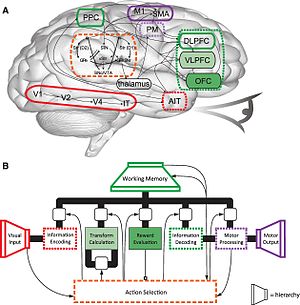
People have amazing ideas, but the computational abilities are often not ready. "At the core we are trying to leverage knowledge the way humans record and communicate in natural human language in a a particular text" (video below), to the point where there is a natural interaction between humans and computers". Ideally, cognitive computing systems expand the boundaries of human cognition and get smarter with use, providing complex information processing systems, able to acquire information, collate and act on it, and transmit it as knowledge.

For example, healthcare. In healthcare cognitive computing can become a "support tool to expand the physicians cognitive boundaries by giving them deeper access to much larger volumes of [selected, filtered, organised] information" (video below). In other words, we are leveraging the computer's ability to keep up with huge volumes of data. Using semantic analysis to recognise patterns the computer is able to understand the knowledge contained within the data, so that it can be applied to the problem that the physician is trying to solve, and give different alternatives, while also providing evidence that supports those alternatives (evidence exploration). The key here is that we are "adapting the computer technology to work better with the way humans want to work so it's a more natural relationship between the human and computer" (video below).

A useful visual introduction cognitive computing, the video (2 mins 6 secs) below, Eric Brown (IBM Research) provides a brief overview referring in particular to Watson. For a much deeper overview, have a read of What is cognitive computing ? IBM Watson as an example.


Image: Simplified diagram of Spaun, a 2.5-million-neuron computational model of the brain. Public domain licensed Wikimedia Commons image by Chris Eliasmith: https://en.wikipedia.org/wiki/File:Architecture_of_Spaun.jpeg

Tuesday, April 26, 2016

Time for dreaming, criticising, and being realistic....

I sometimes work with coachees who will come up with a strategy, and then immediately add the tag “that won’t work because…”. This focus tends to result in some great ideas and strategies never getting off the ground as a result. 
The Disney Strategy was developed by the Neuro Linguistic Programme (NLP) practitioner, Robert Dilts. Dilts based the strategy on the approach Walt Disney used with his creative teams to support them to develop ideas. The underpinning concept is that, even if a person has a way of thinking that they find most comfortable, any person can consider something from three different perspectives and switch between them. The approach can be used with individuals, or with small and large groups.
The reason the Disney Strategy works so well in situations where the person is their own worst critic of their ideas is because of the three separate modes: Dreamer, realist, and critic. The strategy, even when coachees are initially sceptical, is effective in part because it also acknowledges a coachee’s perceived barriers - but not until they have explored their initial ideas.
The Dreamer mode is where I encourage all the coachee’s new ideas - the focus here is purely on (positive) creative suggestions and on invention. The sky’s the limit! Barriers and issues have no place here because they are acknowledged in the next two modes.
In the Realist mode I encourage my coachee to consider how to make their ideas work in practice. This is the mode where ideas become detailed plans (with milestones and timelines) that are likely to work in the coachee’s context because it integrates complexities.
The final mode, the Critic gives space for the coachee to look for flaws in their ideas and to identify what might go wrong. This mode helps ensure that the coachee ‘audits’ their idea, registers risks, and considers mitigations; it is a way of keeping the best of an idea - maybe using it as a springboard for a second idea - at which point the coachee and I would work through all 3 modes again. Alternatively, possible big picture fixes could be taken back the the dreamer mode and other two modes again if an idea still holds merit but has some apparent issues.
I carefully facilitate each mode, clearly defining the associated ‘rules’ and describing the modes. Shifts from mode to mode can also be signalled by different coloured items of clothing if the approach feels comfortable.
In brief the Disney Strategy provides time and opportunities for an idea mature and develop because:
  • My coachee can generate a range of ideas quickly, and cannot immediately jump on what they see as flaws, concerns or risks.
  • Idea / brainstorming spaces can be shared in advance of a coaching session to start the coachee’s creative energies flowing.
  • Using communication links between the dreamer and realist, and then the realist to critic, avoids the critic directly making comment about an idea in the early stages, thereby keeping the energy level high and positive during the dreamer mode.
  • The approach can break habits of constantly scanning for, and criticising, flaws in a suggestion, which can clear the ‘log-jam’ and allow ideas to flow more freely (i.e. less “that won’t work here because…”.
  • By working through one mode at a time, the dialogue remains focussed and is not undermined by the possible distractions caused by the other modes.
  • Ideas that have gone through the Disney Strategy are likely to be way more robust.

Image

Message stones. CC ( BY ND ) licensed Flickr image by: Roselyn Rosesline - https://flic.kr/p/eTzoib

Tuesday, April 12, 2016

Getting your goals right

Coaching has a wide range of definitions and approaches. One of the most prevalent understandings is that coaching comprises “a collaborative relationship formed between a coach and the coachee for the purpose of attaining professional or personal development outcomes which are valued by the coachee” (Spence & Grant, 2007, p. 185). Couched within this understanding is the importance of goal-focused activity with a clearly defined outcome. A person embarks on a coaching relationship because they are working through a challenge, or a goal that they want to attain, and they are looking for support to develop effective strategies and solutions (Grant, 2013). As such, a big part of development is setting effective goals that will enable a person to plan and identify clear directions to achieve their desired change.
Beyond the practical aspects of goal-setting, research indicates that setting and evaluating your own goals play a large part in sustained motivation and ongoing action, even in the face of emerging issues (Bandura, 1998). The process of associating attainment of stated (valued) goals with self-satisfaction has a direct influence on “how much effort [a coachee]... expend[s]; how long they persevere in the face of difficulties; and their resilience to failures … [and these contribute]  to performance accomplishments” (Bandura, 1998, p. 75).
There are several characteristics to effective goals … and some common mistakes. I’m now going to briefly discuss a few of them.
Challenging but attainable
Goals need to stretch you, but still be attainable .. within your stated timeframe. So, if you have never run a step in your life and are not in the best of shape, it is unlikely, for example, that you will attain a goal of winning a marathon in a month’s time. However, if you decide you would like to run a marathon in say, 4 hours, in a year’s time, and put together a training plan with milestone goals along the way, then you are likely to achieve it. So, a long-term goal, with incremental steps (and celebrations) along the way, and with enough challenge to keep you interested, is the way to go.
Specific and within a timeframe
A mistake that is often made is to identify a goal that says we will try harder, do more of something, or improve a skill. However - how will you know you are making progress, or have achieved what you have set out to without some ‘measure’ that will enable you to evaluate how you are doing. You goals should be as tangible as possible, and specify how many, of what, and by when. Using the example above about the marathon, if, as a sub goal you decide to run the Auckland 10km race in April in under 1 and a half hours, it would be easy to know if you have or have not achieved the goal. It’s not always easy to set such specific goals, but the more specific you can be the greater your sense of progress will be.
Positive
Sometimes it’s tempting to identify what we don’t want - things (emotions, behaviours, contexts) we’d like to avoid - rather than looking at what we do want. It is, though, way easier to actively set out to do or achieve something than it is to try to avoid doing it. Again, taking the example of the marathon, compare ‘I will stop eating biscuits until after I have run the marathon’, with ‘Up to when I run the marathon I will eat at least one salad a day, except for Monday which is my day off when I will eat 1 biscuit’.
Other things to include in effective goals
As well as the three key areas discussed above, it is good to also keep in mind the following characteristics of effective goal setting so that you include:
  • clear direction to attain your desired change,
  • clarity of priorities (which will inform your ongoing decision making),
  • identification of resources available to you (including people),
  • clearly stated tasks and activities that align directly with specific aspects of your goal(s), and
  • specific links to your performance and personal development
(Southern Institute of Technology, n.d., n.p.)
Even if you set effective goals, sometimes you’ll feel as though you aren’t making progress or that other things are derailing your efforts. At times like these it is good to talk with your coach to work through responses that will help you stick with your long-term goals, while maintaining your motivation - and sanity!
Terry Pratchett in his novel The Wee Free Men sums up the importance of goals as opposed to dreams as follows: “If you trust in yourself. . .and believe in your dreams. . .and follow your star. . . you'll still get beaten by people who spent their time working hard and learning things ...” (Pratchett, 2004, p. 21). Dreams can be incredibly motivating. However, you need to sit down and work out how to turn them into them reality, and setting effective goals is part of that process.
Image
Back in time. CC ( BY ND  ) licensed Flickr image by Hartwig HKD: https://flic.kr/p/6zXq7Y
References
  • Bandura, A. (1994). Self-efficacy. In V. S. Ramachaudran (Ed.), Encyclopedia of human behavior (Vol. 4, pp. 71-81). New York: Academic Press. (Reprinted in H. Friedman [Ed.], Encyclopedia of mental health. San Diego: Academic Press, 1998).
  • Burdett, J. (2005). The listening paradox. Organizational Performance Review, 7-9.
  • Castleberry, S., & Shepherd, C. D. (1993). Effective Interpersonal Listening and Personal Selling. Journal of Personal Selling and Sales Management, XIII(1), 35-49.
  • Grant, A. (2013). The Efficacy of Mentoring - the Benefits for Mentees, Mentors,  and Organizations. In Jonathan Passmore, David B. Peterson, and Teresa Freire (Eds). The Wiley-Blackwell Handbook of the Psychology of Coaching and Mentoring Series: Wiley-Blackwell Handbooks in Organizational Psychology. Chichester, UK: Wiley-Blackwell. pp. 16 - 34.
  • International Coaching Federation. (n.d.). ICF Core Competencies. Retrieved from http://www.coachfederation.org/files/FileDownloads/CoreCompetencies.pdf.
  • Pickering, M. (1986, Fall). Communication. Explorations, A Journal of Research of the University of Maine, 3(1). pp. 16-19.
  • Rogers, C R., & Farson, R.E. (1987). Active listening. In Communication in Business Today. Eds. R. G. Newman, M. A. Danziger, & M. Cohen. Washington C.C.: Heath and Company
  • Rothwell, J. D. (2010). In the company of others: An introduction to communication. New York, NY: Oxford University Press.
  • Salem, R. (2003). Empathic Listening. In Beyond Intractability. Eds. Guy Burgess and Heidi Burgess. Conflict Information Consortium, University of Colorado, Boulder. Retrieved http://www.beyondintractability.org/essay/empathic-listening
  • Southern Institute of Technology. (n.d.) Transformational Coaching and its outcomes (Module A) [Lecture notes]. Retrieved from CBC105 (NET).
  • Spence, G.B., & Grant, A. (2007) Professional and peer life coaching and the enhancement of goal striving and well-being: An exploratory study. The Journal of Positive Psychology, 2, 185–94.
  • Whitworth, L, Kimsey-House, K, Kimsey-House, H, & Sandahl, P. (2007). Co-active coaching: New skills for coaching people toward success in work and life. Palo Alto,California: Davies-Black Publishing.

Monday, April 4, 2016

Place yourself - on a scale of one to ten...

Most people will be familiar with the 1-10 scale … from surveys and polls for example, where the focus is abstract things such as opinions, beliefs and emotions rather than concrete things like the number of things we do and how many hours we take to do them. In other words, the 1-10 scale enables a person to make a subjective response, in a way that reflects how they think and feel - i.e. their own assessment. In a coaching context it enables the coachee to make an initial response and then discuss, in a solutions-focussed way, the strategies or other factors that may help them shift on the scale. It also enables them to compare their original response with their target state. The approach has the added benefit that it is easily understood and doesn’t require a lot of explanation.
As part of using the scale it is important to describe, based on the conversation up to that point, what the coachee’s ‘10’ might ‘look like’, as well as a brief description of their ‘1’. For instance: ‘On a scale of 1 to 10 where a 10 is your ideal outcome where you feel totally comfortable with achieving what you have stated in your goals, and a 1 is where you feel uncomfortable and don’t feel you will be able to achieve your goals…where would you place yourself?’
Other variations might be - on a scale of 1 to 10...
  • ... how [insert suitable opinion / emotion word] are you with using [insert suitable skill or action]?
  • …since we last talked how much progress do you feel you made towards your goal?
  • …how confident do you feel with this approach?
As a coach you can use the 1 to 10 scale as a way to help your coachee identify their commitment to go through with an action. If you ask ‘how committed are you to completing this action before we next meet?’, your coachee is likely to respond something like ‘very’. Compare this with asking ‘on a scale of 1 to 10, where 10 is you will definitely do it, and 1 is you almost definitely won’t do it, where would you place yourself?’. An 8 or more is likely to indicate that a question to see what would make it a 10 is likely to be useful. If the response is 7 or less it is probably worth spending more time working through some underlying issues that are creating barriers.
The 1 to 10 scale can also be used as a way to encourage a coachee to assess their position, explore it further, and then identify ways to move forward. Usually, a coachee will place themselves somewhere between the two extremes. A response of 5, for instance, could be followed up with a positively framed question such as ‘You have chosen 5 - what things are you contributing to the team that have led to you choosing a 5?’ And then ‘If you feel you are now at a 5 what other things can you do to move yourself to a 6?’
However, the scale should be used sparingly and sensitively in a way that appreciates what is best for the coachee at that moment, in their context (Wallis, 2013). Consider the following scenario - a coach is working with Abni. Abni has recently been promoted to team leader (one of her goals), and she is really pleased, but also a little apprehensive about whether she is going to live up to the role. As one of her goals she has identified that she wants to implement a new process that will support the team to be more collaborative.
The coach asks: On a scale of 1 to 10, Abni, how confident are you that this new process will bring about the results you are looking for?
Abni responds: A ‘7’.
The coach follows up with: Hmmm, so what would it take to increase your confidence in the effectiveness of the process to a 10?”
Wallis (2013) highlights some of the issues with this approach and some of the assumptions that are being made, including:
  • The coach makes an implied judgement that a ‘7’ is not good enough, and the assumption is being made about something as unmeasurable as confidence.
  • There is an assumption that a ‘10’ is required to help ensure the effectiveness of the process.
  • The underlying suggestion that perfection is what Abni should be aiming for in relation to her level of confidence - something that is nigh on impossible given that her confidence is likely to be based on “elements that are ultimately outside of her control” (Wallis, 2013, Para. 10).
Compare the questions above with the following:
The coach asks: ‘Ok, Abni, in order for you to introduce this process to your team next week, what level of confidence do you think would be a score you can move forward with confidently?
Abni: ‘7 out of 10’
The coach: ‘So, what do you think you need to do, or change, in order for you to move in the direction you want to go on this scale in terms of your level of confidence?’
In this second set of questions, the coachee remains empowered and in charge of the scale. She self-assesses and the coach supports her to consider if there are things she could do (i.e. realistic and achievable) to increase her confidence.
The 1 to 10 scale, when used appropriately, can be a powerful tool that offers a way to frame-up and ‘measure’ intangibles that can have a massive influence on our performance and wellbeing. The key is to use it sensitively and just frequently enough to make sure that it remains fresh and effective.

Image

10. CC ( BY ) licensed Flickr image by Paul Downey: https://flic.kr/p/nSwy

Reference

Wallis, G. (2013). One a scale of 1 to 10. Retrieved from http://www.theexecutivecoachingblog.com/2013/02/27/on-a-scale-of-1-to-10/.

Friday, March 18, 2016

'Hows' and 'whys' of active listening

One of the abilities of a coach is the being able to listen - to try to understand another person’s reality, and how they experience and interpret their world. Active listening has been identified as an “important way to bring about changes in people” and an “effective agent for individual personality change and group development” (Rogers & Farson, 1987, Para 3).
Most people have heard of active listening; however, it is a tricky skill to pin down. Active listening (sometimes also known as empathic or reflective listening), is described by Salem (2003) as “a way of listening and responding to another person that improves mutual understanding and trust” (2003, Para 1). On the other hand Castleberry and Shepherd (1993) see active listening as a “cognitive process of actively sensing, evaluating, interpreting, and responding to … verbal and nonverbal messages” (p. 36). There are overlapping aspects to each of these two definitions including (on an intellectual and emotional level) listening to:
  • focus on verbal and non-verbal cues,
  • check accuracy of understanding,
  • acknowledge what is being heard (and observed), and
  • respond appropriately.
Note that the second definition mentions “evaluating”. However, in most coaching contexts the listener ideally reserves their own opinion or judgement (Whitworth et al, 2007) and doesn’t try to change the mind of the speaker. The listener’s removal of their own agenda, and potential associated criticism, is an integral part of being able to “demonstrate a spirit which genuinely respects the potential worth of the individual, which considers [their]... insights and trusts …[their] capacity for self-direction” (Rogers & Farson, 1987, Para 2). It also helps signal to the speaker that the listener sincerely considers them worth listening to, and that they believe the speaker has something to contribute.
So, active listening in coaching is about you focussing on the other person and listening to what they are saying without interrupting them. It’s about using your own words to act as a sounding board and reflect back to the speaker that you hear their point of view. When someone is listened to, “they tend to listen to themselves with more care and to make clear exactly what they are feeling and thinking” (Rogers & Farson, 1987, Para 3). As such, you need to check your understanding of what has been said - or hasn’t (for example, the gaps and hesitations that reveal feelings and attitudes underpinning the words). This approach enables you to find out more and explore possibilities, as well as to establish real empathy, trust, and mutual respect.
Essentially there are three aspects to active listening: comprehending, retaining and responding (Rothwell, 2010).
  • Comprehending: encapsulates the notion of shared communication, and indicates that meaning will need to be identified, negotiated and acknowledged. The aim is to be attentive to what is being said, as well as to other verbal and nonverbal cues. Because there is often other noise, the listener may need to filter it out so that they don’t become distracted.
  • Retaining: Memory is an integral part of the listening process and is part of how we process sounds into meaning. Focussed, mindful listening are therefore essential, because momentary lapses in concentration (sometimes caused by visual distractions) can affect memory and retention such that you hear inaccurately, or have to ask for clarification or repetition.
  • Responding:  Both the speaker and the listener in a successful communication, are interested and active. The listener will be providing feedback that they are interested via noncommittal responses (e.g. “uh huh”), or short questions (e.g. “I’d like to hear more about that”). In face-to-face contexts they may use other visual nonverbal cues too. Depending on the feedback the speaker is receiving, there may be the decision to adjust the communication approach, or even bring the communication to a close.
Active listening is a skill on which you can work. It takes practice to listen and focus on what is being said without bringing in your own agenda. It is a skill that develops the more you use it, and is likely to need you to also reflect on your own underpinning beliefs. Is it worth the effort? In groups that use active listening people are likely “to listen more to each other, to become less argumentative, more ready to incorporate other points of view” (Rogers & Farson, 1987, Para 3). Also, those who develop their active listening skills are likely to establish deep relationships, while also positively impacting their own attitudes; truly a “growth experience” (Rogers & Farson, 1987, Para 3).

References

Castleberry, S., & Shepherd, C. D. (1993), Effective Interpersonal Listening and Personal Selling, Journal of Personal Selling and Sales Management, XIII(1), 35-49.
Rogers, C R., & Farson, R.E. (1987). Active listening. In Communication in Business Today. Eds. R. G. Newman, M. A. Danziger, & M. Cohen. Washington C.C.: Heath and Company.
Rothwell, J. D. (2010). In the company of others: An introduction to communication. New York, NY: Oxford University Press.
Salem, R. (2003). Empathic Listening. In Beyond Intractability. Eds. Guy Burgess and Heidi Burgess. Conflict Information Consortium, University of Colorado, Boulder. Retrieved http://www.beyondintractability.org/essay/empathic-listening
Whitworth, L, Kimsey-House, K, Kimsey-House, H, & Sandahl, P. (2007). Co-active coaching: New skills for coaching people toward success in work and life. Palo Alto,California: Davies-Black Publishing.

Image

In conversation. CC ( BY ) licensed Flickr image by Catriona Savage: https://flic.kr/p/6xEzVr