Wednesday, May 18, 2011

Digital Citizenship and Online Safety (a session facilitated by Nancy Groh)

Netsafe beta community spaceImage by hazelowendmc via Flickr

Today was the first session of the Paepae Hot Seat session, Digital Citizenship and Online Safety, kindly facilitated by Nancy Groh from Netsafe. Netsafe are the developers of the Learn, Guide, Protect site, where educators and the wider community can share resources around digital citizenship and online safety. The idea is that educators develop "an online repository of material schools can use and adapt to promote a student-centred approach to digital citizenship and cyber safety" (Nancy Groh).

Nancy opened by asking everyone to introduce themselves and where they currently are, in the chat box - a nice way to see who is doing what as well. She then moved on to a short re-cap of using computers and cybersafety since 1998. It was amazing to see that no-one in the group were using computers in classrooms in 1998, and no one had cell phones. The phenomenal changes since then were then described, and ICT was seen as the norm, and those that don't have Internet access are now marginalised. Her own son came across the situation where 4 out of 5 universities had no other way to apply to them except online.

Internet AccessImage by whurleyvision via Flickr


Mobiles and consoles are now seen as 'the net', and provide 'Google in the pocket'. Nancy then went on to say that it's not just in the pocket, but also in the kitchen, bedroom...and bathroom!!!
Nancy covered the four 'truths' of cybersafety. The message is that if something worries a person that is online, that they should tell a significant adult about it. The problem is that many people speak to peers rather than approaching 'authority' figures.
In a short survey conducted with the audience when showed an image of a girl at a school crossing, about 42% felt the child was safe, for a range of reasons such as visibility, and adult supervision. If the adults are taken out of the picture, 42% also agreed that she was safe...but with the caveat that it depended on her prior experience and training. The discussion was then tied to the three elements of learn, guide, protect, and then Nancy introduced  another picture with two young students in front of a laptop with no clues around external context, and asked "how safe are these girls?". It was interesting the discussion in the backchannel around this point including "depend on many other surrounding factors", and "Very few kids know the problems...just think they do".

A leader teach is able to help this student wi...Image via Wikipedia


From the NZ Curriculum key competencies Nancy showed nine points about what makes a digital citizen. On the list 'ethical behaviours' and 'critical thinking' were highlighted in a different colour. Research Nancy has conducted suggests that the ICT words should be taken out of the list of digital citizen descriptors, and that the behaviours described should be across the board, not purely online. A diagram was used to illustrate some of the key aspects of cybersafety conceptually. The combination of key competencies and digital capability are shown as all parts of the same conversation.

In further research Netsafe has conducted, the percentage of educators who believed that their students understand ICT use agreements, about 30% disagreed or were not sure that students understood the ICT use agreement that they had signed. The real challenge around the concept of digital citizenship has to bring in the context in which you are working. Nancy shared two images, one of a nude male and one of a sculpture and asked participants to think about their reaction if they saw a 7 year old student looking at the images if they were studying photography or classics, and in a situation where they weren't. Would we react any differently? If someone else who was unaware of the context in which they were being used saw the 7 year old student viewing, how might they react? A really interesting point!

Bullying was discussed, and it was suggested that there is often a small, identifiable group that is often the main source of bullying within a school. As such, targeted education around bullying has been found to be effective. Surveys were also identified as a good first step to outlining a school culture - and the surveys can be (and have) be conducted and presented by the students themselves. Other strategies are more senior students working with younger students to help them with cybersafety and provide peer support.

Illustration of Facebook mobile interfaceImage via Wikipedia

Involving parents was seen as an interesting challenge. Willowbank School in Auckland was talked about as an example where the school is using Facebook to communicate with parents. It's a primary school, so there was a lot of discussion with the students as why this is happening. The parents have responded very positively around the enhancement to the communication. Bring your own device was mentioned as another challenge (as well as the incredible benefits) - but again, it was seen as incredibly important to involve parents.
The session was tied up with a discussion around some of the key points that had been raised, including the issue of support within schools for teachers who become enthusiastic about innovations, only to not receive the support and become dispirited.
A very informative, thought-provoking session with a very lively backchannel! If you are interested in finding out more about what happened during the session, please access the recording by clicking HERE.
Enhanced by Zemanta

Wednesday, May 4, 2011

Disrupting Class: How Disruptive Innovation Will Change the Way the World Learns

If you are involved in leadership in education...either in role, thought, or example...you are likely to find this video of interest.


Michael Horn outlines the theory of disruptive innovation, looks at it in connection with business, and then creates parallels with education. He suggests "With education, the question becomes how to apply disruption as a positive force, propagating new ideas that are relatively simple to adopt and that offer an inviting, student-centric alternative to the often tradition-bound processes of many school systems. Horn cites online learning as a disruptive innovation that has particular potential in education, especially when you consider the number of non-consumption opportunities that exist. Dropouts, home-schooled students, school commuters, incarcerated youth, tutoring, professional development, adult lifelong learning, are all areas with large groups of potential online users. And most students sitting in K-12 classrooms do not yet have available the range of benefits possible with online learning, from 24/7 access, to personalized education, rapid assessment and progress tracking." (source).


Tuesday, April 26, 2011

Technology for Emirati teacher trainees: Thoughts and opinions (Guest Blogger - April 2011)


This blog post was written by Glenys Henry (whose bio is below). Glenys is currently working with Emirati women who are enrolled on the Bachelor of Education Programme at Dubai Women's College in the United Arab Emirates.


Dubai Women’s College a brief overview

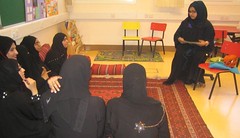
Dubai Women’s College is a government university, where local women are educated and given the skills and qualifications to work. The college has a strong focus on preparing women for the work place. In my role as faculty on the Bachelor of Education Programme, my students spend time on internship in local and international schools. In the international schools the students for the first time interact with western teachers. The school norms and environment in international schools are very different from those in Emirati schools.

International schools follow a western emphasis on time keeping, are very task focused and demand our teacher trainees to be professional according to the school cultural context. Government schools focus more on relationships; tea is served and food is offered on arrival.

During the 4 years of the programme, many of the students are married, and this is a challenging and exciting time. Mothers with new babies are entitled to two weeks leave after the birth of a baby and then continue with their study. It is common for grandmothers to take responsibility for the children while the students are in college.

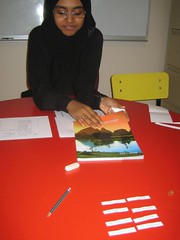
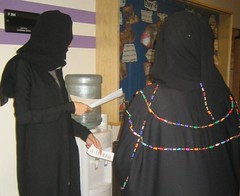
The blogs that follow are student responses to the question: Why is technology important for Emirati women in the UAE, in 2011.

 
Image by kind permission of Glenys Henry
(all rights reserved)
Alyaa
Behind the shayla and abaya ( the traditional clothes of women in the UAE) we are ordinary. The Arab women are like any other women around the world. We take care of ourselves, we use technology everyday and in fact we can’t live without it. Technology is very important to me as a student mother, because when I’m in college I have to call my mother to check on my baby. However my mother has some difficulties when using the mobile phone because technology was not popular in the past. Nowadays we use technology for everything, like ordering food. If there was no technology in the UAE I believe we’d be much healthier because we eat a lot of fast food. Still, I tend to believe that our lives would be imperfect without technology.

Shaikha Saif
In my opinion technology is important in my life because it facilitates our communication, getting to know people and makes finding information easier. I will tell you a funny story about my father. He thought girls should only use computers for study but that boys could use them for whatever they wanted. Over time my father changed his mind. Now he asks me to teach him how to use it. I want women in other countries to know that women in the UAE use technology like women everywhere.

Ghassoon
Technology has become important in the life of today. It is technology which has sped up our lives in the UAE. It has brought distant locations closer and has made the world a smaller place. My parents didn’t use technology till now because in the past there was no technology in the UAE. My parents are Bedouin.

 
Image by kind permission of Glenys Henry
(all rights reserved)


Shaikha Saeed
Technology is an important part of our life communication with others. I believe that without using technology there’s no communication. Many people are using technology to increase their business and their creativity. The reason that technology is important is because without it we are lost and bored. If I need something from my family or friends, even late at night I can text them on my blackberry. If I need to call my family and I’m alone somewhere they can drop me or take me there.

Nada
I do respect people’s thoughts about us as Emirati women. Some people think we are strange because of the black clothing, shayla and abaya but the truth is it all comes from our religion as well as our traditions. Women nowadays are different because of technology. Technology in the UAE is getting more advanced every year. Some schools in the UAE use laptops rather than books. Dubai is a country that tries hard to make people’s lives easy and comfortable by having good technology. An example of this is transportation in Dubai. We have a metro with computerized drivers. Other examples include blackberries, internet and iphones. Women in the UAE are getting educated to help their community and work with technology. One day we will find technical instruments made in Dubai. Technology makes life easier.

Maryam Ismael
When I was 11 years old, I used the computer for the first time. It had a very big screen and it was difficult to start. I used the computer for doing school tasks and sometimes to play with my sister. For me technology is very important. I can’t imagine what I would do without it. I use it everywhere, at home and outside. It makes my life easy. Sometimes I need to order from outside for lunch or dinner and I’m lazy to go out. Before I couldn’t meet my friends but nowadays I can call them anytime and we can meet. I also use my lovely computer to download movies. I believe my life wouldn’t be complete without technology. It is part of my life and my soul.

 
Image by kind permission of Glenys Henry
(all rights reserved)

Fatma Ibrahim
Nowadays technology is very important to everyone but for me it is very, very important. It’s part of my body. When I was 13 years old I had my first phone and that was after a long discussion with my mother. In the beginning she disagreed about this. I was crying and crying. My mother brought me a phone and I was happy and excited. I was the first in my class to have a phone. I realize now it wasn’t the phone that was important but being the first to have one.

Huda
When I first had a blackberry I found it to be a silly phone. Once I had one, I realised I could connect with family. I’m very quiet and I don’t like to talk to people very much, so many people didn’t know my personality. Now that I connect every day with my mobile my family in Kuwait knows more about me. So technology is very important for me.

Sara
Technology is very important. It is like a basic thing in life. It’s impossible to find a person who is over 10 years of age who doesn’t know how to use a computer. A lot of people have the wrong idea about us Arabs, especially Arab women. They think we are not allowed to have laptops or even go out. If they came to the UAE they would be shocked how even 10 year old girls have their own mobile. I’m not saying that’s in all families. Some families are still old fashioned and old ideas. I think that the old ideas are right and should not be changed because as technology is needed, we find we can’t live without it. It is taking our lives. We’re giving too much of our time which we can spend doing other useful things.

 
Image by kind permission of Glenys Henry
(all rights reserved)

Shaikha
I’m Shaikha and I’m a 21 year old Emirati girl. Technology is the most important thing in my life and I think it’s the same for most girls in my country. My parents use technology but not as much as I do. They use mobiles to call us and ask about us if we are outside the house. For me, I use it everywhere. I can’t forget the first time we had a computer in our house. My Mum and Dad were very shocked and they didn’t accept it but later when they knew more about it they knew how important it is.

Fatma
I remember when I was a child and we had a huge, ugly, old computer just like an elephant. Actually the keyboard was broken and I had to copy the letters from websites and paste them in my space. I remember that if I wanted to write a short sentence it took me 10 or 15 minutes and that was a challenge for me. Nowadays technology is much easier. We can use laptops and advanced options. We can now make new friends all over the world and complete our work faster than before. My parents use technology and they taught me how to type on word documents and how to use PowerPoint and fortunately that helped me a lot.


Glenys Henry-Teacher educator, Dubai Women’s College, United Arab Emirates

Glenys is an experienced teacher educator and NLP life coach from New Zealand. She has worked in a range of contexts and is currently training Emirati women in the United Arab Emirates to teach in government schools in the UAE. She has been in Dubai since 2000. She is also a life coach, and in this role, works with successful women who are looking to increase their performance. As a Personality Dimensions facilitator, Glenys has facilitated workshops in educational and corporate environments. This has been proven to promote self awareness, tolerance and improved communication and understanding.
currently training Emirati women in the United Arab Emirates to teach in government schools in the UAE
Enhanced by Zemanta

Thursday, April 21, 2011

Fourteen top tips: The perks and pitfalls of social media in business

Free twitter badgeImage via Wikipedia

Following advice from the session presented by Catherine Frethey-Bentham, the top tips (not in any particular order) for businesses wanting to use social media include:
  1. Focus on a marketing strategy; i.e. figure out your aims before jumping on board with all the tools (sounds familiar) ;-)
  2. Listen to your customers, and have people who respond to queries and comments immediately
  3. Make people the experts...don't market at, market with
  4. Allow people to speak about your brand - sometimes in a negative way. You need to be able to respond to that in a positive way and use it as a springboard to improvement
  5. Use videos - people are much more likely to watch them through to the end
  6. Be yourself instead of fully trying to control your image
  7. Consider focussing on 'small acts' rather than large campaigns
  8. Bear in mind that people are busy - put the important points at the beginning of a blog post for example
  9. Shift from being 'hard to reach' to 'available everywhere'
  10. And remember that social networking does not replace marketing
  11. Make sure that you respond to comments or queries, and to ask and answer questions
  12. Use a friendly casual tone. The idea is to 'get talking'.
  13. Retweet and re-post - a good way to engage followers
  14. Don't spam people with company-related information.
"Networking is not about hunting. It is about farming. It's about cultivating relationships. Don't engage in 'premature solicitation'. You'll be a better networker if you remember that."
Dr Ivan Misner (author & founder of BNI).


Internet Marketing Strategy Using Search Engin...Image by hongxing128 via Flickr

People like to be engaged. They like to have a conversation, and be listened to. The idea therefore is to build a narrative or occasion that people want to become engaged in - that they identify with and want to become a part of...that they want to be related to. Something that is fun...has an emotional aspect. Catherine showed us the example of the Colgate mini wisp campaign where people sent in pictures of themselves, played an associated game, and interacted in various ways - they had 1.6 million views of the campaign. They learned the value of what engagement is. Colgate is now wanting to expand the campaign and continue to actively measure the 'value' of engagement.

Catherine moved on to talk about the NZ Consumer views on social media marketing 2010 - 57% feel better served by socially engaged companies 56% feel more engaged; and 51% want companies to interact with them using social media. On the whole 25-50% of people want companies to interact with them using social media. In NZ about 72% of people are on Facebook, but the use of Bebo is declining rapidly. LinkedIn only has an uptake of 8%. You Tube has been accessed by 76% of NZ-ers; 14% use Twitter, and 38% have read and/or written a blog.

Research on Iran. by Negar Mottahedeh Social M...Image via Wikipedia


A recent survey from 2100 companies by Harvard gave the top 10 benefits of social media to a business, which included:
  1. Increased awareness of an organisation
  2. Increased traffic to website
  3. Greater favourable perception op a brand
  4. Increase in new business
  5. Identification of new product or service opportunities
The 'but' is 75% of companies did not know where/whether their most valuable customers were talking about them. Only 7% of companies were able to integrate social media into their marketing activities, and nearly a third do not measure the effectiveness of social media.

BUT - social media is not for every business, especially if you:
  • Are a struggling business requires all of your attention
  • Have little experience on the web
  • Have no marketing plan
  • Have no implementation budget
  • Have no on-going commitment
Risks include:
  • Too much time maintaining the presence
  • Downtime risk
  • Social media page under someone else's control
  • Brand issues and negative feedback, for example a negative You Tube video that goes viral
How do you measure success with social media?
  • Decide what you want to measure: E.g. exposure. search engine rank, unique visitors
  • Engagement? E.g. page views etc.
  • Action?
Google Analytics were recommended as one way or measuring, and others mentioned were Hootsuite
Tweet feel, Tweet reach, Sentiment Metrics, and Knowem.com to check out your personal brand name (go and reserve your domain name). A final recommendation of more information around the subject was the online (free) publication What's Your Personal Marketing Strategy by Sumitra Dutta.

Thoughts about the presentation
 
Non Profit Content Marketing StrategyImage by Russ_Henneberry via Flickr
This event was organised by The Auckland Executive Club whose membership is aimed at senior management, business women and aspiring business women, and women with specialist skills. The speaker of the evening was Catherine Frethey-Bentham who is spoke about how marketers can use social media to their advantage, and how to measure the usefulness of social media campaigns.

Interestingly, a quick search showed that although Catherine has a Scribd and a Slideshare account, she has nothing uploaded...and I was unable to locate a Twitter or LinkedIn account :-)

It was a an engaging start to the presentation where Catherine walked the walk, and opened by asking the audience to vote on what they would like her to talk about, ranging from a video about what social media is, tips for using social media, and the benefits that social media can offer a business. The audience chose about 5 of the 9 options - a great, inclusive way of engaging the audience in the process.

She then moved on to show one of the videos that give some of the facts and figures about social media and social networking. It was awesome to see how the audience was absorbed by the video - music and images really capture a wide audience, and inspire people to think in different ways. There were several side discussions about the points raised ("only 14% of consumers trust advertisements", for example!).

Overall it was a useful introduction for anyone who is not familiar with social media and its possible impact on business growth. It was an engaging presentation, that was relevant and a number of practical tips and tools to take away - just right for the audience I think, and well worth attending.

Enhanced by Zemanta

Wednesday, April 20, 2011

Examples of and research around laptops used with Primary (Elementary) students

Image source by Lisa Parisi

I am incredibly fortunate to be working with a wide range of educators from around globe, and one (Linda Ojala), inspired by a video by Claire Amos: Welcoming laptops into the classroom: Tips and strategies, responded:

"I  liked Claire's strategies and tips and will share some of these with the teachers I work alongside. I'd really like to know some great strategies for using lap tops in the primary sector where only 1 student in the class maybe working in this way.  I still find it difficult to get teachers away from the focus of using laptops only for games and publishing work.  I have come across that fundamental belief that is held which is that children should still be using pencil and paper, even if they find it difficult to manually record their ideas."

So, I set out to see what I could discover. Interestingly a simple search brought up a few studies (listed below), but few concrete examples and footage. A bit more digging brought to light other examples, although often the focus was on the technology rather than what strategies were being used to engage the students and enhance their learning experience. I have listed below a selection of what I found, but would be really grateful, if anyone has some great tips and strategies they want to share, or know of other examples, please comment below :-)
Image source by Lisa Parisi

There are a couple of videos that capture the student voice and opinions around using laptops in their learning, and 1:1 Learning @ St Albans Meadows Primary School (Australia) is an interesting one (with a nod, I think, to Michael Wesch). This video from Teachers' TV captures some teacher opinions, as well as demonstrating some possible uses: Primary ICT - Laptop Pros and Cons.

For actual, concrete examples, Lisa Parisi (who teaches fifth grade on Long Island, US, using a collaborative classroom model...one regular ed teacher and one special ed teacher), has some superb ones. Lisa is a great reflective practitioner, and you may want to follow her blog to hear about her triumphs, trials, and tribulations (for example, Best Day Ever)! In particular the award-winning collaborative writing project regarding the book, The Mysteries of Harris Burdick, by Chris Van Allsburg - you are able to visit the students' wiki and see the stories that were generated by the students (aged 9 to 12, from 14 classes located in the US, Australia, and New Zealand). You can also hear Lisa interviewed, and watch a short video about the project. All the students used Skype conferencing, wikis, and a range of other strategies to build and share their stories...a great example of where the communication, collaboration and learning was the focus...and the technology just enabled the process.


Other examples include:
I'm sure you'll be interested in the efficacy of using laptops in primary classrooms. Benefits and challenges of using laptops in primary and secondary school: An investigation at the Eastern Townships School Board 
 is a very recent report (2011) covering research conducted in Canada to better understand the challenges and benefits of using laptops in primary and secondary education. The report looks at pedagogical uses as well as providing 10 key recommendations. There is much in the report that can be applied to education settings around the developed world.


Enhanced by Zemanta

Tuesday, April 19, 2011

Empowering students: Some ideas of how learners and teachers might use Skype & IDroo to collaborate


In this video Chitose Izuno shows Hazel Owen how she has been using Skype and IDroo with her learners of Japanese. They then go on to discuss some ideas around the potential of IDroo to empower learners to collaborate, and also opportunities to lead sessions, reflect, and add to their ePortfolio.

A discussion about the impact of the study of metacognition on classroom practice

Logo for Ready Set LearnImage via WikipediaIf you are looking for a paper that covers metacognition and how it affects learning outcomes, then it is worth reading Nayana Karia Metacognition and Classroom Practice: A discussion about the impact of the study of metacognition on classroom practice. Karia, having given an overview of metacognition and its importance in human development, then goes on to explore notions of the reflective practitioner, as well as strategies around group work, peer tutoring, and reciprocal tutoring. There are several examples of what this might 'look like' when some of the approaches are used with learners, including hyperlinks to resources.


An extract from the paper (Karia, 2007, p. 12) reads:: "A move to newer models of assessment necessarily implies a change in teacher focus from content to strategy instruction. To this end, teachers must be offered training to enable them to accurately perceive student aptitudes, preferences and motivational beliefs. Students must be encouraged to individualize strategy knowledge and teachers must instruct for both far and near generalization (Maccini and Gagnon, 2006). Changes in instructional strategy must be preceded by changes in teacher training offerings. There are also inherent weak links in a system that allows young learners to formulate their goals based on perceived task value. Today’s teachers must be all the more sensitive of the need to scaffold learners in the formation of goals, strategies and self-evaluation. And, they must be aware that:

“The key factor at the heart of successful scaffolding is not only the ability of the more able learner/teacher to offer appropriate help, but also their ability to withdraw or fade the support they offer when the learner is ready.” (Luckin & Hammerton, 2002)

Metacognition
Enhanced by Zemanta