A blog covering all aspects of ICT Enhanced Learning and Teaching (ICTELT) where the focus lies on ways of scaffolding and empowering learners.
I am a strong advocate of the potential of Web 2.0 and social learning to empower learners from all walks of life and cultures.
Me, us, you - over time we make connections, grow and expand out thinking. Over time we come back together in groups to connect with people we know. The collaborations that develop from those connections can be incredibly powerful.
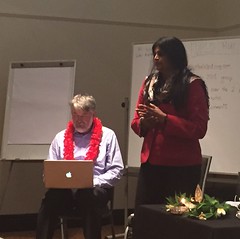
Heather Eccles, Krishna Ramadugu, and Geoff Wood highlight that much of their professional learning has been about specific collaborations and connections that they have made, initially by being part of the Virtual Professional Learning Development (VPLD) programme. Krishna talked about light and what it means to her: "It's the lamp of knowledge that can light the fire of thousands more and yet not diminish in its brilliant. It benefits both the giver and the receiver".
Krishna made contact with Geoff, who heads up the Over the Back Fence (OTBF) project. Where there are connections between students with the older students leading sessions for the younger students (tuakana teina). There have also been sessions where authors have beamed in for sessions with the students, and connecting different cultures with groups in India.
Some of the outcomes, for all the learners, have included the enjoyment of students learning from each other in a way that is experience driven, rather than content driven. It has encouraged students to engage and participate, and to embrace new literacies, as well as developing a deep sense of fulfilment in sharing. Curiosity has developed along with a desire to learn and succeed.
Geoff and Anne Kenealley started to talk about connecting classrooms at a bus stop after a conference. Since then the project has burgeoned, with students running sessions online with other students around the world. The connections have been amazing, opening up worlds and windows on cultures and understandings that otherwise wouldn't have been possible. It's the global connections - the questioning of early-formed beliefs, and a way of helping the youth shape their understandings of the world.
Going back to the whole notion of connections - they are myriad. They involve young learners, older learners, teachers, education leaders...all with a thirst for learning and eye for the potential of the affordances of technology. Bringing us back to...it's not the technology...it's what you do with it!!
So - what connections are you making? How are you exploring and opening up the world of learning for yourself? How are you empowering your learners to open up their own world?
We are so lucky to live for as much of our time as possible in a place up in the north of New Zealand, that we love.
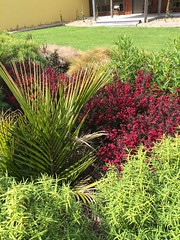
Over the last 5 or so years (and after doing a lot of homework) we have planted over 20,000 trees and plants (see pic on the left to see what it looked like in Year 1!). We have planted a lot of native trees, heaps of trees for bird food, and a lot of plants that have blossom for bees (see pic on right for a Year 4 comparison - including over 500 lavender plants, and a couple of hundred rosemary plants).
Through trial and error, as well as by seeking advice from the wonderful folk in the neighbourhood, we learned what would and wouldn't grow, when and where. We also planted our orchard, and have planned our veggie gardens.
Next step - the bees. A while ago I'd bought a book on beekeeping, and decided that full scale beekeeping may be a step too far...but I had heard, and read a bit, about folks who were keen to keep their hives in suitable places such as (fingers crossed) ours. By dint of a chance conversation, Grant Engel from Revolutionary Beekeeping Ltd came to see our place, and to my delight, is going to bring his fabulous bees to work with us!
Grant will come to check on the bees to make sure they are healthy and well-fed, and he also harvests the honey they produce with his innovative mobile honey harvester (see videos below for a demonstration). In return, these fabulous insects will make the most of the blossoms, including in our orchard and (soon) veggie garden, and in turn do a wonderful job of fertilising the flowers so we get fruit and veg. O - and the pot of honey a month will be a fabulous treat - plus we get to be serenaded by gentle buzzing.
I love the reciprocity of the whole cycle, and was also particularly impressed with Grant's enthusiasm for his bees and for beekeeping. Revolutionary Beekeeping states that they will not only "provide a service that will support, educate and fairly reward our clients", but that they will also "continue to create innovative technology that will make beekeeping easier and more enjoyable", and "focus on the health and sustainability of beekeeping as it plays a vital role in global food production" (source). Can't be better than that!
At the end of the day - the whole process has been about planning, finding out what is needed, applying, learning (often through mistakes), hard work, trying different approaches, and figuring out next steps...sound familiar? :)
This inspirational video illustrates very clearly what an incredible responsibility we have as educators. A reaction can undermine a learner's confidence, and leave them with an "I can't response" if we're not really careful. However, sometimes from set backs, great things can grow, and Kiran Bir Sethi, from Ahmedabad, India, after her son experienced a blow to his learning, has started a "movement of empowerment and education that has reached over 30 countries – impacting more than 25 million children. She shares with the audience what happens when learning environments are infected by the 'I CAN' bug and how design thinking has been used to create empowered individuals who can be agents of change" (source).
The description that accompanies the video reads "Kiran Bir Sethi is a designer and director of The Riverside School, but also the founder of the 'Design for Change' - the world’s largest movement of change – of and by children. Based on four simple steps - Feel, Imagine, Do and Share - children around the world have developed ideas and projects to drive social change in their society. She shows vivid and inspiring cases of social transformation that promotes optimism in education. Her talk asserts that new and better things are possible and that each of us can make change happen. After this talk, you will realize that change is the result of a process that can be consciously nurtured and energized " (source).
Would be great to hear what you think about the 'I can' approach underpinned by design thinking - and similar things that you are undertaking with your learners (of all ages). Please leave responses in the comments below.
Shared by Darren DeMatas, How to Make a Podcast, is a really clear, easy-to-follow, step-by-step guide, which uses a range of multimedia to demonstrate and inform anyone who is interested in podcasting.
The guide also includes some indicative pricing if you are serious about getting into podcasting.
Buzzsprout, who produced the guide, offers a hosting option. The option has a free plan available, and you don't need to enter your credit card details to sign up.
I'd highly recommend this guide!
A review of the report can be found by clicking this hyperlink . A brief highlight of some of the key aspects of the report is:
"The experts agreed on two long-term trends: advancing learning environments that are flexible and drive innovation, as well as increasing the collaboration that takes place between higher education institutions".
"Regarding the challenges for universities and colleges, improving digital literacy is considered one of the solvable challenges".
"Bring Your Own Device (BYOD) and the flipped classroom are expected to be increasingly adopted by institutions in one year’s time or less to make use of mobile and online learning. The time-to-adoption for makerspaces and wearable technology are estimated within two to three years, while adaptive learning technologies and the Internet of Things is expected to be mainstream in universities and colleges within four to five years."
I think there there are few in New Zealand and beyond who will not be aware of Nigel Latta. He has been involved in a few TV series and documentaries, including around education.
Starting with a discussion about science, Nigel talked about his experience of doing a session about gravity hanging out of a window, and then another about hyperthermia...and what it's like to hang out a window in an uncomfortable harness, and then standing in a freezer for an hour and 15 minutes in a shirt. Interestingly, it was when he came out that he started to get hyperthermic.
He mentioned that he likes engaging people in education - and science is seen as a "distant aunt who doesn't come to the Christmas dinner and that type of stuff". "If you are talking to kids about climate change"..."it's all important, but as you read the supporting documents a little bit of your start to shrivel up". "It's about engaging people in the world". Rather, if you say "do you want to see something that's freakin' cool...which could is going to say no?". Nigel demonstrated with a time lapse view of the heart beat of the planet as ice forms and melts.
Using the example of the 'story' of the Harley Davison and the image as a way of hooking people in, realising that "the stuff that you've got is really cool". "Maths is the perfect example. I went all the way through school thinking that maths was boring". It was only later that he realised that maths is fascinating, and exciting! (and highlighted a podcast about Prime numbers where the speaker was incredibly passionate).
Nigel moved on to the question "Why does a civilisation dominated by experts find it so difficult to respond to reality rather than ideology?" (John Ralston Saul), and talked about some instances where experts from outside of communities make decisions that make no sense in context. It is underpinned by the notion that "providers are self-interested whereas providers in Wellington has everybody's interest at heart". He moved on to a quote by Edward de Bono "you can't dig a hole in a different place by digging the same hole deeper" - in other words doing the "same old same old stuff doesn't work" you keep doing the same thing!
Statistically stuff changes in people's lives, so if you stand close enough to some of the "worst cases" you are able to benefit from some of the reflected glory - it was said humorously, but it made a great point. He goes on to describe listing all your assumptions, and crossing off all you are sure off and then the two or three that are left over at the end of the process they are often the ones that contain the seed of what is actually happening and might be influenced.
"When it comes to thinking we are not very good at it". Nigel gave a thumbnail sketch from the beginning of the universe to now, and on the way through indicated that humans developed to cooperate, collaborate, and create. Part of this process is refining tools and tweaking them to do things that haven't been done before - and Nigel showed the video of the astronaut who made the first music video in space. In part it was to show that curiosity and 'amazement' can lead to astounding progressions...some of which are to make life better. He also made the point that "basically we are using the same stone age brain".
We also have a way of filtering what we do or do not believe, giving the example of standing on the scales weighing yourself - "if you like the number you see" you accept it, if you don't "you get off and fiddle with the knobs" etc. We are pretty poor when it comes to thinking and making decisions. Some of it, system 1 thinking is instinctual (e.g. and angry cat), the system 2 takes a lot of energy and brains don't necessarily want to expend a lot of energy, especially when humans were hunting and gathering. "If a bat and a ball together cost $1.10, and the bat costs $1 more than the ball...how much does the ball cost?" (answer below :D). We didn't develop to solve problems like this, and we haven't developed to have the number of relationships we currently do. Which means we are having to adapt and change...and that is why "change is so hard".
The more we do something the more we 'hard-wire' it into our brains. For instance, if we learn the piano it starts off as difficult but then gets easier...and we can't 'un-learn' it. So - change is really uncomfortable as we are having to 're-wire'. Human beings are therefore influenced by this, and are pretty terrible at making decisions. It's really worth checking out Daniel Kahneman and his research. As such, the idea of certainty is the most dangerous thing. We all make dumb decisions, and understanding that we make such poor decisions and planning is a myth.
All the time "opinion is reported as fact", and research is misinterpreted and incorrectly summarised and presented. Therefore, Nigel feels that data is really important and can provide parts of a puzzle that can inform the picture - and opinions - we then form. Data tells you things about the world that you don't know (however - note from me - a caveat is that it does depend on how the human(s) who collect the data, interpret it - humans have been 'certain' about things based on data, until it has been re-interpreted, often when other data becomes available).
Nigel then moved on to talk about Carol Dweck's work about fixed and growth mindsets. "If you have the growth mindset and feedback ... when you get the option you will go for the hard option" - the growth mindset. So, it's more positive to say to a young learner that 'that was really good, you worked really hard', rather than, 'that was really good, you're really smart'. The former keeps the door open, even in the face of things going wrong - encouraging experimentation and risk, the latter - when you hit a snag, suggests that you are not smart. Anything is possible for almost all human beings, it's all to do with strategy, attitude and effort. "Human beings work on a growth mindset model".
John Hattie's research, “Visible Learning”, has collected data that illustrates, for example, class size doesn't matter, but micro-teaching and feedback does (you can find a brief summary on this site). The most powerful predictor of success is students' expectation of themselves. So, if you have an environment with young learners and a constant focus of raising expectations of themselves, there is likely to be a consistent raising of achievement. You can change people's expectations of themselves!
Nigel brought us back to engagement, and how to engage people - or how people become engaged. Often big industries are risk averse, such as TV. He told the story of how he got worked to get the opportunity to make a programme in the Antarctic. What he really hopes is that "kids will start to watch this and think science is really cool", and want to get into science as a profession. "There are jobs that you can do in science that are astoundingly interesting". This has led him to make a science show to bring science back to TV - and making it interesting, fun, and relevant.
I really enjoyed this session - entertaining, thought-provoking, a little bit provocative. It definitely provided some ideas around 'how'. Your thoughts? Please share in the comments below :D
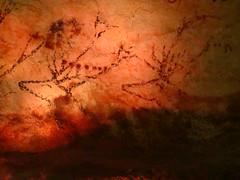
'Cave Deer' http://www.flickr.com/photos/28110584@N04/2973134645 Found on flickrcc.net
'AK3' http://www.flickr.com/photos/34097675@N04/5275351422 Found on flickrcc.net
Answer to maths problem = 5 cents
Sunday, February 1, 2015
Adam Fletcher's willingness to share his expertise, his drive to support youth, and his ability to challenge entrenched thinking, never fail to inspire me! So, it was great to find that Adam had been working hard to write and make available his latest book, which I highly recommend: A Short Introduction to Youth Engagement in the Economy FREE (81 pgs, 2015).
Over the last six months, Adam explains, he has "written more than a dozen articles about youth engagement in the economy" (source) that cover some of the "most forward-thinking about economic youth engagement" (source). He has compiled them into a publication, weaving the key themes together, and adding a number of important points.
Some of the questions he asks to help raise awareness in specific contexts include:
What opportunities are there for youth engagement in the economy through your workplace, program, organization, school or community
What does youth engagement cost?
How is youth engagement funded?
How is youth engagement financed (e.g., parents, building partnerships, government sources, making better use of resources, etc.)?
How is youth engagement in the economy sustained in your community?" (p. 77)
In the guide, Adam is "addressing youth employment, youth entrepreneurship, youth training, youth banking, youth programs, school classes and other activities" (source). He suggest that employers, youth workers, teachers, and others committed to building the economy through youth engagement, would find the guide of interest.
If you have already downloaded and read the book, please share with your networks. You can also check out Adam's other free guides, on his website. Please support Adam's amazing work.







 Posts
Posts


