Wednesday, September 23, 2015

Underpinning theory and practice with kaupapa Māori: Mobile learning framework

My friend and colleague whaea Yo Heta-Lensen has observed that "online and blended learning courses are often written to instructional design guidelines that have been developed from a specific theoretical viewpoint taking a one-size fits all approach that cares little for indigenous knowledges" (Heta-Lensen, in press).

It was great, therefore, to see He Whare Ako He Whare Hangarau, work done by Dr Acushla Sciascia and Dr Claudio Aguayo, as part of the NPF14LMD - Learners and Mobile Devices Ako Aotearoa National Fund Project.  Would be good to read your thoughts and reactions :)

Acushla and Claudio share that the He Whare Ako, He Whare Hangarau framework weaves "kaupapa Maori theories, values and approaches to learning and teaching (ako) and provides distinct mobile learning parallels of theory and practice, conceptualised into the visual of a metaphorical wharenui (traditional meeting house). The framework depicts the relationship between ako and mLearning and engages a range of pedagogies that are culturally responsive and that are open to the affordances of technologies. The framework is a values-based approach to understanding the role of mobile devices in the learning context".

Key objectives include:
  • Locating the teacher/learner at the centre and consider both as co-learners / co-teachers
  • Underpinning theory and practice with kaupapa Māori values such as whanaungatanga, kotahitanga, whakamana, manaakitanga, etc
  • Weaving mLearning theories and frameworks that espouse best practice   teaching and learning strategies using technology
  • Encouraging new approaches and pedagogies for teaching and learning that are culturally responsive
  • Conceptualising how the affordances of mobile learning and devices contributes to the learning process and overall learner experience
You can read an overview here: https://drive.google.com/file/d/0B-PzrzVpHIroNGhDSVF6elR4UUU/view, and watch the video below as well as access the accompanying Prezi presentation.
.

Thursday, September 10, 2015

Ka Hikitia: Phase 5 (2010-2012) report

Jill Parfitt kindly shared the latest report on Te Kotahitanga effectiveness to be released by the Ministry: KA HIKITIA - A Demonstration Report Effectiveness of Te Kotahitanga Phase 5 2010-2012.
An excerpt from an introduction to the report reads:
Notably, Effectiveness of Te Kotahitanga Phase 5, 2010-12 finds that: “the achievement of Māori students (as measured by NCEA levels 1–3) in Phase 5 schools improved at around three times the rate of Māori in the comparison schools,” “the proportion of Māori students coming back into year 13 increased markedly in Phase 5 schools,” and “by 2012 the number of year 13 students achieving NCEA level 3 in Phase 5 schools was nearly three times what it had been four years earlier.” (p. 2)
Te Kotahitanga was a gem of a program from an international perspective, not only for its sound theoretical basis, its well-conceptualized model of teacher professional development, and its positive impact on Māori student outcomes, but also for its consistently wise use of research. (p.3)

Image: Kahu huruhuru. CC ( BY NC ND ) licensed Flickr image by hazelowendmc: https://flic.kr/p/jzwj5P

Friday, August 28, 2015

Student voice and cultural responsivesness

This powerful post was shared by Manu Faaea-Semeatu, where she looks at a poem called "Voice" that she wrote last month and featured on her blog. Would be awesome to read your thoughts and reactions.
Manu writes" The principal of Holy Family School in Porirua - Chris Theobald (@The0bald) reached out to me on Twitter to ask if he could film two students reciting the poem. Enjoy!"
Voice
a poem inspired by expectations and and hesitations. . . 
I am expected to speak
Eyes bore into mine as I make eye contact
I wait patiently, waiting for an opportunity
None is given
Should I interrupt and make a case for myself?
I struggle internally, this is not how I'm raised
I must sit quietly and wait for a chance to speak
I need to find my voice
You expect me to speak
But do you want to listen?
Can you really hear what I'm saying?
You are impatient
Should I interrupt and make you listen?
You struggle internally, this is now how you're raised
You stand tall, and take up every chance to speak
You need to find my voice

Introducing Joziah and Ethan - with two different approaches to the poem :-)

]

Monday, June 1, 2015

Metamorphosing from traditional to modern learning practices

Modern learning pedagogy is likely to be a long slow journey, with a number of mistakes made along the way, and it's not always going to be easy.

Headspace is key, advises Vicki Hagenaars. You need to have your head in that space; to have been immersed and exposed to a number of different environments. It is essential to listen to the students as well. Students will often raise questions or requirements that may not have otherwise have been considered.

Often the stages taken are 1) connectivity, 2) a change in environment, and 3) then a change in the way of learning via, for instance, communities and reflective portfolios.
One of the initial things that was used in step 1 in the example Vicki shared was a blog (blogspot) - that was owned and populated by the students. The site has now had over 1000 hits, and the students are delighted. It was quite a big step forward for senior management as they weren't sure about having the students voices and images out in the public space.

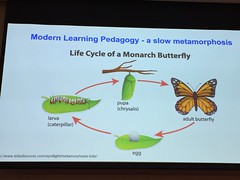
This was the caterpillar stage. The computers went into the classrooms, and the desktops were, over time, replaced by laptops. The infrastructure, however, was really dodgy. This has since changed.

The process is slow, and often painful. The caterpillar has to disintegrate and re-assemble into the butterfly to then emerge and fly.

The art of teaching is the art of assisting discovery...

Friday, May 29, 2015

Cultures making connections

Students who identify as Pasifika, whose cultural background is one of the many the Pacific Islands - what is their experience of learning in a school around Ashburton, Christchurch - Ashcoll to be exact? And if you take a large pinch of Ceilidh, a heap of enthusiasm, and a wide range of cultural backgrounds - what happens? Nearly 8% of the students at Ashburton College are Pasifika.

In the school there are no teachers from the Pacific Islands so the teachers step up as leaders. At the Ceilidh, there were breaks so there was a wonderful moment where the students were dancing in the interval to the delight of the Scottish fiddle band. It was the most amazing connections between disparate groups of people who would not normally have connected. Teachers, students, people from the community, laughing, talking and having fun - the most fun fundraising(for the students to go to Samoa) that was had in a long time...and it was people who would maybe not have been involved.

The kids are running the thing, and you have to 'get over yourself' and engage and be part of it.

It's all about process and progress, and student agency. We can't teach them, they have to teach each other. Five years coming to the VPLD, four years going to the speech fest. Each year we have come away with prizes. All that Marg can do is support, including with practical aspects such as driving around to pick students up for practice - but then all Marg has to do is be there and unlock the door. The students take it from there!


Thursday, May 28, 2015

The discomforts of change

What happens when a school isn't working - for the learners, the community, and the teachers? Sometimes it's a case of bringing in the broom, working with leadership, and then starting again. 
Gavin Clark shared his story from the Board resigning, the Commission coming in, and the subsequent changes in leadership. The school is now undergoing a process of revisioning, which includes consultation with the community and with the learners. 
The arising challenges include the pace of change. The pressure is on to make a difference from day one for learners - and progress is more important than attainment. Other key factors that will help ensure the school can keep up with the rate of change include setting expectations clearly and co-constructing these if possible, and supporting staff to step up and take responsibility for their professional development. 
 In 2014 a survey with students illustrated that students appreciated the integration of technology into the curriculum, but that staff did't value this. As a result, in 2015, this has become a non-negotiable. Staff development is tracked, and student voice is collected every 2 terms, and community voice is collected once a term. Constant reflection is one of the requirements of ensuring that this level of impact is continued. 
 Massive change is possible, but, as Gavin's story illustrates, it isn't comfortable. Some people found it so uncomfortable in this case, they have chosen to leave. The benefits for learners however, appear to be huge. Can't wait to see some of the emerging results from this change.

Image: Silverdale students, From the Silverdale Primary School Web site.

Student agency: Some benefits

Student voice and student agency are key to learning. However, this doesn't always seem to be an unquestioned (inconvenient?) 'truth'.

Lorraine Makatu explains what happens when student agency is supported and nurtured.

Mangere Central School has sister schools in Bali, and Lorraine shares some of the experiences of students who start to explore different places and life experiences in Indonesia and Jakarta, for example. The school web site is the portal, and the families are able to go in and see and ask questions. The students asked questions like: 'what did they eat?', 'Are they on Facebook?', and 'Will they Snapchat with me?'. It was a reality check when one Skype call used the whole Bali school's data for the week.

The students are also involved in local projects such as the SH20 upgrade, where students are working with the environmental managers of the project to help ensure the environment around the school is protected. For example, a culvert was dug and some eels were found. So now, all of the eels are being relocated. The health and safety manager is also being shadowed by one of the students - they are making connections with what is in the school such that students are walking around saying things like 'someone will trip on these shoes'.

These are great illustrations of transference - making connections between knowledge domains, and applying the learnings across them. They also show how students are developing identities, taking on roles, and making connections between their current world views and the other domains around them.