Tuesday, October 20, 2015


iJoos Mind/Getty Images

This podcast, from the awesome TED Radio Hour (NPR), has a lot to think about - especially if you are working in a place where collaboration is king, and anything else is seen as second best. The description from the site advises that "In this hour, TED speakers unravel ideas behind the mystery of mass collaborations that build a better world"; just a small goal :)

To help illustrate a variety of points of view and experiences the podcast presenter interviews TED presenters and weaves together their comments with their TED presentation. The compare and contrast format helps juxtapose some gnarly questions and ideas. Well worth listening to.

I have included from the TED Radio Hour site a selection of the sub 'chapters' in the episode, but you might just like to listen to the full show on Why we collaborate.

Wednesday, October 14, 2015

Meeting the costs of coaching

It was telling for me, in the article “New study sheds light on manager-coaches” (although not so new - from 2009), that those in more senior positions were more likely to use mature coaching approaches because they had the time and space to do so. This finding, for me, indicates that coaching isn’t a panacea to all business issues or a ‘quick fix’ option, although it is effective when properly resourced. As such, it was interesting that coaching was framed by many line managers, who participated in the research study, as a “burden” - a word used twice in four questions from the CIPD report.

There is also a clear indication in the report that many managers are not themselves supported to develop coaching skills prior to starting coaching work with their team members. This could, in turn, help explain why there were both primary and mature coaching approaches identified by the study. Perhaps there is also a need to differentiate between leadership and management? Not all managers are leaders, and not all leaders are managers - and maybe the more participatory  “mature coaching” approach tends to be used by managers who are also leaders?

Ultimately a business needs to really invest in coaching and to integrate it into their culture. This requirement is highlighted by the three key recommendations from the report: 1) coaching needs to be viewed as a business issue; 2) roles and expectation need to be clear; and 3) skills development, resourcing and support are essential. Perhaps this is why consistent use of coaching is “virgin territory” for “three-quarters of businesses” - the initial investment appears to be very high!

Thursday, October 8, 2015

A catalyst for change? Coaching and mentoring

John Whitmore, in his article, Will coaching rise to the challenge? throws down a wero (challenge) for coaching as a profession.
He opens by describing some of the possible benefits of the economic crisis in the States (the article was written in 2009), highlighting the fact that apparent negative setbacks can be a catalyst for review and change. In particular Whitmore outlines how people can be sparked into taking opportunities to escape from the illusion of wealth, especially with support such as that provided by coaching. The process can lead to a change in attitude and viewpoint - both of which are fundamentally important in shaping outlook. Coaches can ask new questions about a person’s job, relationships and lifestyle that can help them re-assess their purpose, life, and values. As such, two primary products of coaching are a growth of a person’s awareness and responsibility, which apply to all aspects of life.
Whitmore also talks about leadership, ranging from the pragmatic (people in leadership roles are often unaware of the benefits and availability of coaching), to the conceptual (we do not need to wait around for the ‘next great leader’). Instead, he advocates for leadership from within, in part through the development of self-responsibility - something that many people need to develop. Coaches, using skills such as asking, as opposed to telling, and pulling rather than pushing, alongside rigorous frameworks and strategies for working with sustainable change, can help people develop the skills to meet and adapt to altering circumstances.
To achieve this, Whitmore asserts that coaches need to keep up to date with current affairs and global shifts - and this is where he throws down the wero - can coaching change? It has already made a move from a one-to-one coaching to working with large groups and institutional change. Can it become more global so that it can impact humanity as a whole? To do this would require a change of focus from individual to collective responsibility, as well as an acceptance that, if a coach’s ideals are more inclusive than the person who they are coaching, then their values need to precedence.

Discussion


I thoroughly enjoyed reading this article, although I had to think long and hard about the notion of the coach’s ideals taking the forefront. The more I mull it over, however, it makes sense. As a mentor working in a group of mentors, we have often discussed how we work with mentees whose ideals differ fundamentally to ours to the point that they are not comfortable on any level. In particular some of the unquestioned biases that a mentee may have. We talked about the skill of asking questions that help a person hold up a mirror to themselves seeming to be essential, as well as carefully asking the difficult questions. There was also agreement. however, that if a mentee’s views were derogatory and extremely biased we would clearly state disagreement. It’s a tricky space to work in, but as Whitmore says, coaching (and I would also add mentoring) has “the means to construct exactly what is most needed all over at this time, the individual and collective responsibility essential for the survival of life as we know it” (Whitmore, 2009, p. 3). Would be great to read what you think.

Reference


Whitmore, J. (2009). Will coaching rise to the challenge? The OCM Coach and Mentor Journal 2009, pp 2-3.

Wednesday, September 23, 2015

Underpinning theory and practice with kaupapa Māori: Mobile learning framework

My friend and colleague whaea Yo Heta-Lensen has observed that "online and blended learning courses are often written to instructional design guidelines that have been developed from a specific theoretical viewpoint taking a one-size fits all approach that cares little for indigenous knowledges" (Heta-Lensen, in press).

It was great, therefore, to see He Whare Ako He Whare Hangarau, work done by Dr Acushla Sciascia and Dr Claudio Aguayo, as part of the NPF14LMD - Learners and Mobile Devices Ako Aotearoa National Fund Project.  Would be good to read your thoughts and reactions :)

Acushla and Claudio share that the He Whare Ako, He Whare Hangarau framework weaves "kaupapa Maori theories, values and approaches to learning and teaching (ako) and provides distinct mobile learning parallels of theory and practice, conceptualised into the visual of a metaphorical wharenui (traditional meeting house). The framework depicts the relationship between ako and mLearning and engages a range of pedagogies that are culturally responsive and that are open to the affordances of technologies. The framework is a values-based approach to understanding the role of mobile devices in the learning context".

Key objectives include:
  • Locating the teacher/learner at the centre and consider both as co-learners / co-teachers
  • Underpinning theory and practice with kaupapa Māori values such as whanaungatanga, kotahitanga, whakamana, manaakitanga, etc
  • Weaving mLearning theories and frameworks that espouse best practice   teaching and learning strategies using technology
  • Encouraging new approaches and pedagogies for teaching and learning that are culturally responsive
  • Conceptualising how the affordances of mobile learning and devices contributes to the learning process and overall learner experience
You can read an overview here: https://drive.google.com/file/d/0B-PzrzVpHIroNGhDSVF6elR4UUU/view, and watch the video below as well as access the accompanying Prezi presentation.
.

Thursday, September 10, 2015

Ka Hikitia: Phase 5 (2010-2012) report

Jill Parfitt kindly shared the latest report on Te Kotahitanga effectiveness to be released by the Ministry: KA HIKITIA - A Demonstration Report Effectiveness of Te Kotahitanga Phase 5 2010-2012.
An excerpt from an introduction to the report reads:
Notably, Effectiveness of Te Kotahitanga Phase 5, 2010-12 finds that: “the achievement of Māori students (as measured by NCEA levels 1–3) in Phase 5 schools improved at around three times the rate of Māori in the comparison schools,” “the proportion of Māori students coming back into year 13 increased markedly in Phase 5 schools,” and “by 2012 the number of year 13 students achieving NCEA level 3 in Phase 5 schools was nearly three times what it had been four years earlier.” (p. 2)
Te Kotahitanga was a gem of a program from an international perspective, not only for its sound theoretical basis, its well-conceptualized model of teacher professional development, and its positive impact on Māori student outcomes, but also for its consistently wise use of research. (p.3)

Image: Kahu huruhuru. CC ( BY NC ND ) licensed Flickr image by hazelowendmc: https://flic.kr/p/jzwj5P

Friday, August 28, 2015

Student voice and cultural responsivesness

This powerful post was shared by Manu Faaea-Semeatu, where she looks at a poem called "Voice" that she wrote last month and featured on her blog. Would be awesome to read your thoughts and reactions.
Manu writes" The principal of Holy Family School in Porirua - Chris Theobald (@The0bald) reached out to me on Twitter to ask if he could film two students reciting the poem. Enjoy!"
Voice
a poem inspired by expectations and and hesitations. . . 
I am expected to speak
Eyes bore into mine as I make eye contact
I wait patiently, waiting for an opportunity
None is given
Should I interrupt and make a case for myself?
I struggle internally, this is not how I'm raised
I must sit quietly and wait for a chance to speak
I need to find my voice
You expect me to speak
But do you want to listen?
Can you really hear what I'm saying?
You are impatient
Should I interrupt and make you listen?
You struggle internally, this is now how you're raised
You stand tall, and take up every chance to speak
You need to find my voice

Introducing Joziah and Ethan - with two different approaches to the poem :-)

]

Monday, June 1, 2015

Metamorphosing from traditional to modern learning practices

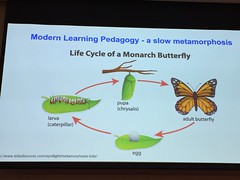
Modern learning pedagogy is likely to be a long slow journey, with a number of mistakes made along the way, and it's not always going to be easy.

Headspace is key, advises Vicki Hagenaars. You need to have your head in that space; to have been immersed and exposed to a number of different environments. It is essential to listen to the students as well. Students will often raise questions or requirements that may not have otherwise have been considered.

Often the stages taken are 1) connectivity, 2) a change in environment, and 3) then a change in the way of learning via, for instance, communities and reflective portfolios.
One of the initial things that was used in step 1 in the example Vicki shared was a blog (blogspot) - that was owned and populated by the students. The site has now had over 1000 hits, and the students are delighted. It was quite a big step forward for senior management as they weren't sure about having the students voices and images out in the public space.

This was the caterpillar stage. The computers went into the classrooms, and the desktops were, over time, replaced by laptops. The infrastructure, however, was really dodgy. This has since changed.

The process is slow, and often painful. The caterpillar has to disintegrate and re-assemble into the butterfly to then emerge and fly.

The art of teaching is the art of assisting discovery...